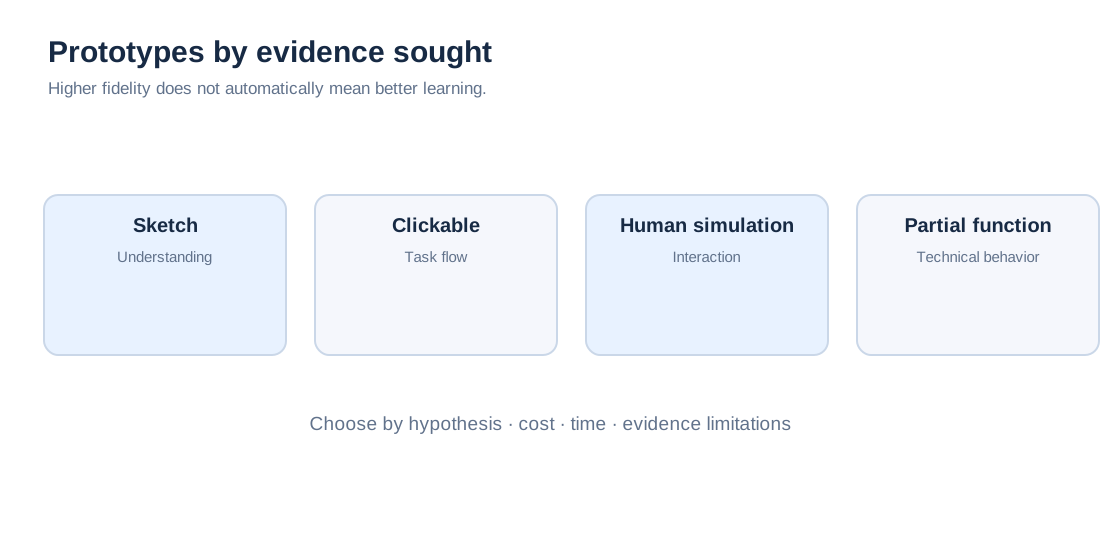
A prototype is a partial representation of a solution used to explore questions before building or committing to the full operation. It may be a sketch, screen sequence, physical simulation, or service performed manually. Different prototypes answer different hypotheses, and greater realism does not automatically produce better learning [R12].
Prototype, wireframe, mockup, MVP, and product
- Sketch: a quick representation of an idea or flow.
- Wireframe: layout, hierarchy, and actions, without requiring final visual design.
- Mockup: a visual representation of a screen or artifact, often static.
- Prototype: an artifact for simulating or experimenting with part of an experience or function; it may use any of the above.
- MVP: a minimal implementation exposed to users to learn about value and behavior; not synonymous with a high-fidelity visual design.
- Operational product: a system capable of delivering the service under its real obligations and constraints.
These terms are not mandatory sequential stages. You can make a very detailed interaction prototype while still knowing little about business delivery capacity. See desirability and feasibility hypotheses.
Fidelity has several dimensions
Nielsen Norman Group distinguishes visual, interaction, and content/command fidelity [R12]. A prototype can look realistic yet store no data; another can look rough yet execute a real feature. “High fidelity” without context is incomplete. Decide which part must be realistic to answer your question.
| Prototype type | Suitable question | Main limitation |
|---|---|---|
| Sketch or storyboard | Is the concept and setting understandable? | Does not measure real use |
| Paper prototype | Can users locate actions and follow sequences? | Requires a facilitator |
| Clickable wireframe | Can people navigate the flow? | May simulate nonexistent results |
| Visual mockup | Is hierarchy and communication clear? | Does not establish functioning |
| Basic physical model | Does shape or handling fit? | Materials may differ from final product |
| Service rehearsal | What is the service experience like? | Capacity and cost may be subsidized |
| Limited functional prototype | Does a particular function behave well? | Does not establish scalability |
Manual simulations: concierge and Wizard of Oz
In a concierge trial a person visibly performs part of a service manually. In a Wizard of Oz test, an interface may appear automated while a person produces some responses; Nielsen Norman Group describes this method and emphasizes operator preparation [R13]. These approaches reduce development investment but require ethical care: do not promise nonexistent capabilities or use deception for consequential customer choices.
Choose according to the question
First identify the hypothesis: understanding the booking process, completing a task, accepting the service, or supporting ten restaurants at once. Then ask how much realism the trial requires, what it costs to build, how long changes will take, and what evidence you expect. Use the experiment selection matrix and prepare a task protocol.
A screen prototype can reveal where a manager gets lost, but it cannot establish willingness to pay S/100 per month. Pricing questions require an appropriate offer and purchase behavior; review pricing and perceived value.
Example: three representations of one service
First: a storyboard shows a booking request arriving and being confirmed. Question: does the team understand the proposed flow? Second: an interactive wireframe asks participants to create and modify a reservation. Measure task completion and where they struggle. Third: a human operator receives messages and manually updates a log during a small authorized pilot, observing time, errors, and workload. Each stage answers different questions; none alone proves scalability.
If the sketch or wireframe spans several touchpoints, compare it with the customer journey and relationship map so you do not test individual screens apart from the wider experience. A journey map highlights friction worth exploring; it does not replace user testing.
What to observe during a test
Do not guide participants toward the correct button. Record tasks, steps, hesitation, requests for help, and errors. Test the prototype before sessions, preserve its version, and document what is simulated. Then decide what to change and which new hypothesis has emerged.
To avoid mistaking facilitator prompts for independent user ability, review bias safeguards during experiments. Record assistance given and distinguish unaided task completion from guided completion.
What you should have by the end: a prototype selected for the question, fidelity, and evidence limitations—not its appearance. Main sources: [R12], [R13], [R18], [R20].
Bibliography and references
- [R12] Nielsen Norman Group. UX Prototypes: Low Fidelity vs. High Fidelity. https://www.nngroup.com/articles/ux-prototype-hi-lo-fidelity/ — Fidelidad de prototipos.
- [R13] Nielsen Norman Group. The Wizard of Oz Method in UX. https://www.nngroup.com/articles/wizard-of-oz/ — Simulaciones con operadores humanos.
- [R18] Strategyzer. Designing Strong Experiments. https://www.strategyzer.com/library/designing-strong-experiments — Precisión de hipótesis, artefactos, participantes.
- [R20] GOV.UK Service Manual. Plan a round of user research. https://www.gov.uk/service-manual/user-research/plan-round-of-user-research — Prácticas piloto y planificación de sesiones.