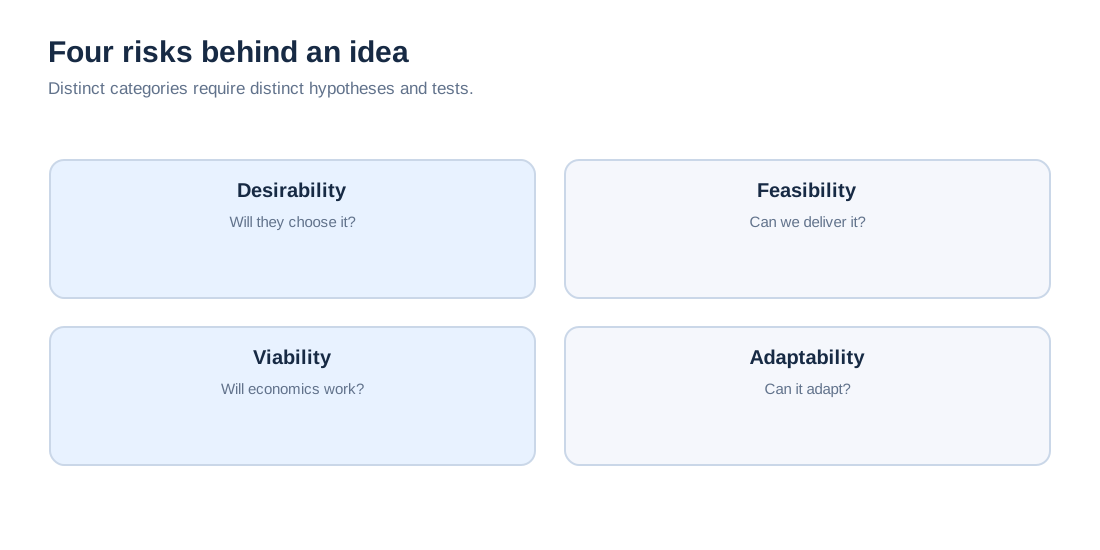
An idea can be appealing and technically possible yet still lose money. Testing whether people “like it” is not enough: we need to distinguish which kind of risk each claim involves. Strategyzer uses desirability, feasibility, and viability, and extends the map with adaptability to changing conditions [R01][R02].
What is a business hypothesis?
A hypothesis is a specific claim about a condition necessary for a business to work that still needs evidence. It is not a goal (“sign 100 restaurants”) or a marketing promise (“we are the best”). Start with “What would have to be true?” If the answer is broad, split it into discrete claims [R01].
Desirability: does anyone need and choose it?
This dimension concerns people: whether the need exists and matters, whether the offering fits, adoption, purchasing, and possible repeat use. Examples: “Managers experience booking errors they want to prevent”; “A share of selected restaurants will trial the service”; “Some will pay.” Expressed interest does not establish actual payment. Previous discovery connects to customer segmentation and value proposition design.
Feasibility: can we deliver the promise?
This covers technical, operational, staffing, supply, and coordination capabilities. “The system can synchronize bookings in less than two minutes with the planned resources” is testable if environment, volume, and measurement are defined. “Our team can handle ten restaurants at once without duplicates” requires observing a real procedure. A beautiful prototype does not establish reliable delivery at scale; see key resources and activities.
Viability: can the economics work?
An economic hypothesis specifies revenues, costs, and conditions for sustaining the operation. “At a monthly fee of S/100 and a service cost of S/45 per client, contribution will cover fixed costs at a given volume” proves nothing until price, cost, and volume are checked. Do not confuse accounting profit with cash availability; a business may report sales and still run out of cash [R02]. For calculations, use costs, margins, and profitability.
To explore how this hypothesis responds to changes in demand, price, and costs, see how to assess a business model using viability scenarios. A favorable scenario does not establish that its assumptions are true.
Adaptability: can it function as conditions change?
This complementary dimension considers regulatory, technological, competitive, and behavioral change. For instance: “We can maintain operations if our primary messaging supplier changes its pricing.” It is useful when dependencies are critical, but it does not make every future uncertainty forecastable [R01].
If a plausible change could disrupt operations, the risk-response and contingency guide explains how to define triggers, owners, and alternatives. Having a response plan does not mean predicting when the change will occur.
One business problem may cross dimensions
| Broad claim | Primary risk | Better-defined hypothesis |
|---|---|---|
| “The service works” | Feasibility | In a two-week trial, the booking log will not generate duplicate reservations in participating venues |
| “Restaurants will buy it” | Desirability | Five of ten eligible decision-makers will accept an explicitly described paid trial offer |
| “It will be profitable” | Viability | Monthly contribution per account will be positive using measured support costs |
| “We do not depend on one supplier” | Adaptability | A documented alternative can cover a defined outage |
All thresholds are hypothetical. Five out of ten is neither a representative sample nor a universal success criterion.
Derive hypotheses from the business model
Walk through the Business Model Canvas. For segments, ask whether the behavior exists; for channels, whether buyers can be reached; for revenue, whether payment occurs; for activities, whether delivery works; for costs, whether the economics hold. Record one testable claim per card, link it to a business-model component, and identify existing evidence.
Avoid blended statements: “It is desirable and profitable” involves at least two separate risks and likely different methods. Next, write each hypothesis precisely and prioritize the important ones.
What you should have by the end: a categorized hypothesis map with origins, evidence, and unknowns. Main sources: [R01], [R02], [R06].
Bibliography and references
- [R01] Strategyzer. How Assumptions Mapping Can Focus Your Teams on Running Experiments That Matter. https://www.strategyzer.com/library/how-assumptions-mapping-can-focus-your-teams-on-running-experiments-that-matter — Tipos de hipótesis, mapa de supuestos, riesgo.
- [R02] Strategyzer. How To Test Your Idea: Start With The Most Critical Hypotheses. https://www.strategyzer.com/library/how-to-test-your-idea-start-with-the-most-critical-hypotheses — Hipótesis críticas y secuencia de experimentación.
- [R06] Strategyzer. How to design and test business ideas. https://www.strategyzer.com/library/the-role-of-an-effective-innovation-coach — Design–Test Loop, pivotar, perseverar o abandonar.