A value proposition is a promise; capabilities determine whether a company can deliver it consistently. The Business Model Canvas separates key resources (what you need available), key activities (what you must do), and key partners (who supports the model) [R01][R04]. This guide connects those blocks with quality, workload, and outsourcing decisions without moving prematurely into day-to-day operations management.
Separate resources, activities, capabilities, and processes
- Resource: available means or asset: equipment, people, funds, data, permissions, premises, or infrastructure.
- Activity: work transforming resources into outcomes: buying ingredients, preparing orders, or resolving problems.
- Capability: the combination of people, knowledge, resources, and practices enabling a dependable outcome, such as dispatching within a promised window.
- Process: repeatable sequence of activities, responsibilities, and checks that produces a defined output.
This is a practical distinction consistent with business model components and quality management [R01][R16]. Sophisticated software cannot replace a process nobody can execute.
Step 1. Start with each value promise
Write: “To deliver ___, we must do ___, using ___.” If Almuerzo Cerca promises to take orders by 10:30 and deliver during lunch breaks, it needs demand information, production planning, payment confirmation, food handling, and route coordination. Do not assume a capability exists just because a supplier claims it does. Revisit the value proposition.
Step 2. Classify resources by type and criticality
Identify people and skills, facilities, tools, capital, information, know-how, permits, and agreements. For each, record cost, owner, availability, potential replacement, and the promise that fails without it. “Key” does not mean most expensive; it means indispensable to the chosen logic. SBA recommends describing the resources and activities that enable value creation [R04].
Step 3. Map the activity chain and dependencies
For food service: estimate orders → buy ingredients → plan menu → prepare → check quality → assign routes → deliver → handle issues. Mark activities that can run in parallel and those requiring predecessors.
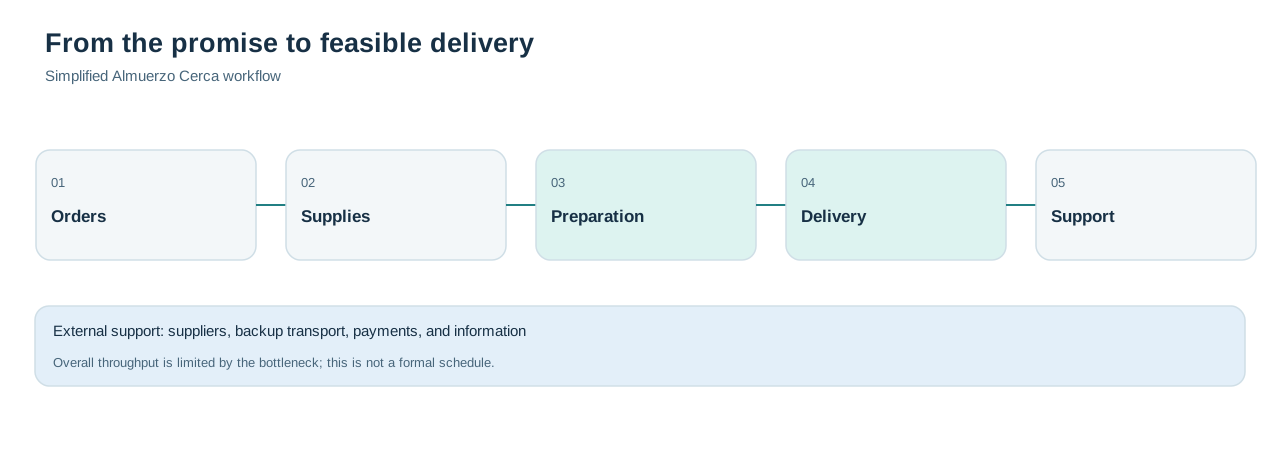
When turning this strategic activity chain into execution work, see how to map dependencies, predecessors, and the critical path. Identifying a business-model dependency is not the same as calculating its duration or project sequence.
| Illustrative promise | Essential capability | Initial quality check | Critical dependency |
|---|---|---|---|
| Delivery within agreed window | Planning and delivery | Confirm capacity before acceptance | Transport availability |
| Clear menu information | Ingredient records and communication | Updated list before ordering | Accurate ingredient data |
| Response to incidents | Staff and support procedure | Named owner and channel | Order-status access |
The table is hypothetical and does not claim certified performance standards.
Step 4. Decide what to build internally and what to buy
Compare control, distinctive know-how, scale, total cost, supervisory ability, dependency, and replacement options. Food preparation may be core to a culinary offer; delivery could be outsourced if a partner can uphold the promise. Yet outsourcing work does not eliminate accountability to the customer. Connect with supplier and partner selection.
Step 5. Define minimum quality standards
An initial standard may describe an observable result: “Every order has an identifier and confirmed window,” along with an owner and a checking procedure. ISO 9001 addresses consistent delivery against applicable requirements; a small business does not need to become certified to learn from quality-management principles [R16]. Do not invent service guarantees or compliance rates.
Step 6. Compare capacity with expected volume
Illustrative assumption: a kitchen can prepare up to 22 lunches daily over 26 days: theoretical capacity of 572 units per month if conditions hold. This does not prove demand, ingredient availability, or the ability to deliver every lunch simultaneously. A 400-unit central scenario appears to leave theoretical headroom; 560 units would approach the limit and make disruption more consequential. See costs and scenarios.
Capacity can be checked through a well-defined operational experiment with explicit volume, duration, and tolerances.
Once model-level capacity has been estimated, the execution resource and capability-gap inventory checks actual equipment, productive hours, staff, materials, and substitutes. A strategic capability on paper is not necessarily contracted, installed, or available on the required date.
Step 7. Identify fragile points and possible replacements
Ask what happens if staff are unavailable, a main ingredient runs out, the ordering system goes offline, or the sole courier cannot work. Sketch preliminary backup options and their cost. Detailed contingency plans and owner schedules belong to pillar 4.
To turn these preliminary options into actionable safeguards, see how to design risk responses and contingency plans, including owners, activation criteria, and response costs.
Common mistakes
Listing tools without linking them to outcomes; declaring everything a “key resource”; promising quality without observable criteria; underestimating third-party oversight; assuming theoretical maximum capacity is sustainable capacity; and confusing a documented process with one that works reliably.
Determine capacity from the weakest constraint
A kitchen nominally able to prepare 22 lunches daily is not automatically a service able to deliver 22 orders: routes may handle only 15, the supplier may provide ingredients for 18, or the confirmation process may fail earlier. For each stage, record theoretical capacity, operating conditions, and bottlenecks. Whole-system throughput is constrained by the limiting stage when flows and units are comparable. If expected demand exceeds the constraint, change the promise, resources, or timing; do not merely edit the number in your Canvas.
What you should have when you finish
Resource inventory, activity-and-capability map, critical dependencies, preliminary outsourcing choice, minimum quality standards, and operational limits. Sources: [R01][R04][R07][R16].
Bibliography and references
- [R01] Strategyzer — The Business Model Canvas. https://www.strategyzer.com/library/the-business-model-canvas — Nueve bloques interdependientes y uso iterativo del Canvas.
- [R04] U.S. Small Business Administration — Write your business plan. https://www.sba.gov/business-guide/plan-your-business/write-your-business-plan — Componentes comerciales, económicos, socios y capacidades.
- [R16] ISO — ISO 9001:2015 Quality Management Systems. https://committee.iso.org/sites/tc176sc2/home/projects/published/iso-9001-2015.html — Principios y requisitos de consistencia de calidad, sin alegar certificación.
- [R07] Nielsen Norman Group — Service Blueprints: Definition. https://www.nngroup.com/articles/service-blueprints-definition/ — Frontstage, backstage y procesos de soporte.