Parallel work does not automatically shorten a project: it helps only when tasks do not compete for the same resources and their outputs can be brought together on time.
Understand a dependency before assigning dates
A dependency is a relationship that constrains when an activity can start or finish relative to another. A predecessor comes first or enables a condition; a successor depends on that relationship. A work inventory identifies what must be done; an activity network determines the logical sequence. Do not invent a dependency merely to justify a desired end date.
Distinguish mandatory constraints arising from safety or the nature of the work, external constraints arising from third-party delivery or approval, and discretionary sequences chosen for convenience. An enforceable authorization cannot be skipped because the team is in a hurry; a preferred sequence may be reconsidered if the evidence supports it.
Four relationships worth knowing
| Type | Meaning | Example |
|---|---|---|
| Finish-to-start (FS) | B begins when A is finished | Install equipment after preparing the space |
| Start-to-start (SS) | B may begin once A starts | Log findings as a trial starts |
| Finish-to-finish (FF) | B cannot finish before A finishes | Finalize report after data collection |
| Start-to-finish (SF) | B finishes after A begins | Shift handover; relatively uncommon |
Leads and lags allow overlap or planned waiting within a relationship, but should not conceal actual work. If a supplier requires five days to ship, document that waiting period and its origin rather than arbitrarily adding five days to another task.
Build the network step by step
- List coded activities with clear outputs.
- For each, ask what condition must exist before it can start. Choose predecessors on logical grounds.
- Identify independent tasks that might run simultaneously, subject to available resources.
- Add estimated durations and assumptions from the estimating guide.
- Calculate earliest starts and finishes from left to right. A task with multiple predecessors waits for the latest of their finishes.
- Work backward from project finish to find the latest permitted starts. Under these assumptions, late start minus early start gives total float.
- Check people, equipment and calendars before calling the resulting schedule realistic.
Worked example: a ten-working-day network
The following durations and dependencies are hypothetical and deterministic solely for illustrating the calculation:
| ID | Activity | Duration | Predecessors | Early start | Early finish |
|---|---|---|---|---|---|
| A | Prepare workspace | 4 days | — | 0 | 4 |
| B | Install equipment | 3 days | A | 4 | 7 |
| C | Evaluate supplies | 5 days | — | 0 | 5 |
| D | Rehearse operations | 2 days | B, C | 7 | 9 |
| E | Review launch | 1 day | D | 9 | 10 |
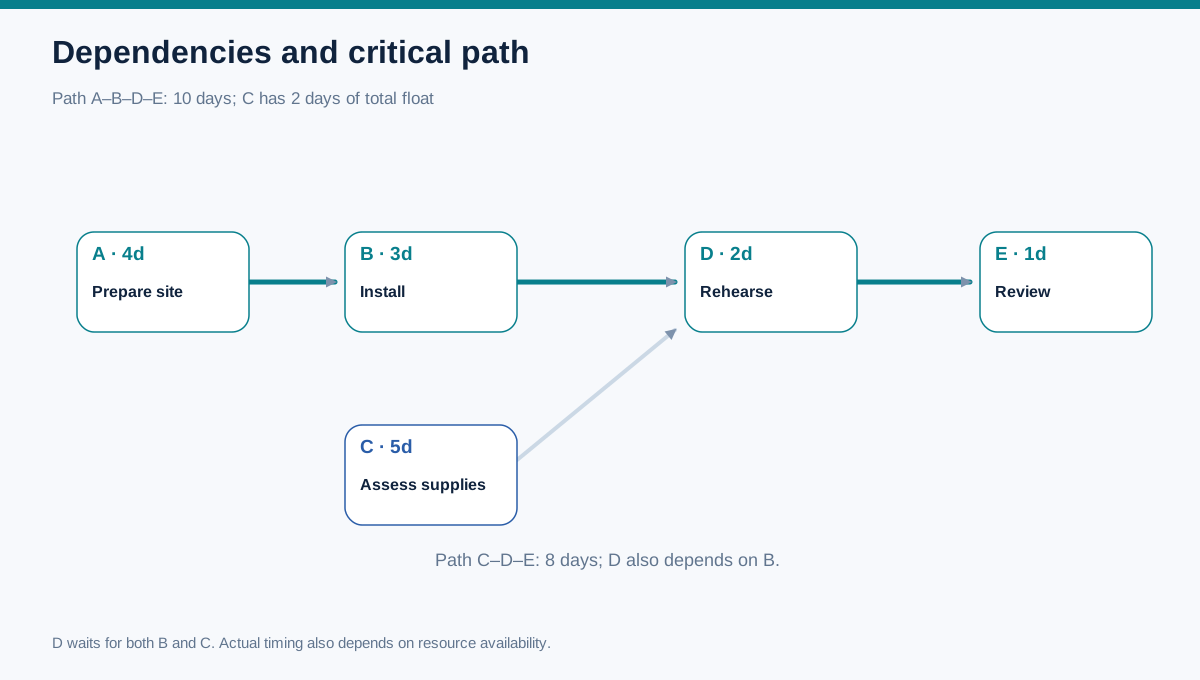
The path A → B → D → E totals 10 days; C → D → E totals eight. Activity C has two days of total float if the model assumptions hold. A delay of two days on C can consume that float without shifting completion; a delay of three can extend it. If A takes five rather than four days, the critical path extends one day.
Real constraints and mistakes
A network may show parallel tasks, but if they both require the only available technician, the plan needs resource leveling. Authorizations and third-party deliveries create external deadlines and risks. An activity with float today may become critical after another task slips. Avoid circular dependencies (A depends on B while B depends on A), unjustified hard dates and links that merely reflect preference.
If an external authorization is a predecessor, see how to research legal and operating requirements to identify the evidence that actually permits the activity and which lead times remain unconfirmed. Filing an application is not receiving approval, so the dependency remains open.
Link the network to the Gantt chart and contingency plan. APM explains that critical-path analysis identifies the sequence constraining earliest completion within the network assumptions [R04].
Logical, external, and resource constraints: a second check
In the five-activity example, A (4 days) → B (3) → D (2) → E (1) forms a ten-day path; C (5) → D finishes with two days of float in the simplified network. This is a logical network without calendars or resource limits. If the cook must perform both B and C, those tasks cannot truly overlap; resource leveling may change the schedule. The WBS defines required results, not their sequence.
To check whether B and C can actually overlap, use the resource and capability-gap inventory: record who will carry out each activity, when, and with what available capacity. A logical network alone does not establish that parallel execution is feasible.
| Dependency | Classification | Evidence needed | If unmet |
|---|---|---|---|
| A → B: fit-out before installation | Logical / mandatory in this setup | Accepted site preparation | B cannot start |
| B and C → D: installation and supplies before tests | Finish-to-start in this model | Equipment and supplies available | Test not valid |
| Approval → regulated activity | External, only if applicable | Competent authority evidence | Affected activity blocked |
| One person allocated to B and C | Resource constraint | Confirmed available hours | Duration/path may change |
Choose finish-start, start-start, finish-finish, or the uncommon start-finish relationship based on real logic, not to make a Gantt chart look tidy. If a supplier gives a three-day delivery lead time, that may be a justified lag, not three days of labor. A lead requires evidence that partial output can be used safely.
Record predecessor, successor, relationship, source of constraint, and owner. Check for circular links, slow external approvals, and arbitrary dependencies designed merely to make the schedule neat. The v2 workbook includes a dependencies table and a dated Gantt; the logical diagram still holds, but a real schedule must account for actual calendars, holidays, and resource availability.
What you should have when you finish
A readable network, a predecessor table, critical-path and float calculations, calendar assumptions and a list of external dependencies requiring monitoring.
Bibliography and references
- [R04] Association for Project Management — What is scheduling in project management?. https://www.apm.org.uk/resources/what-is-project-management/what-is-scheduling-in-project-management/
- [R05] PMI — Practice Standard for Scheduling — Second Edition. https://www.pmi.org/-/media/pmi/documents/public/pdf/certifications/practice-standard-scheduling.pdf?v=c7ca2721-8c26-4e07-ba47-069d0987bc0c