A task list comes after understanding what outcomes the project must produce. Starting with scattered tasks makes it easy to overlook whole deliverables.
Scope, deliverable, work package and activity
Scope defines what belongs in the project and what does not. A deliverable is a distinguishable, verifiable outcome: “dispatch procedure tested,” not “do dispatches.” A work package is a manageable portion of a deliverable. An activity is an action required to produce it, such as testing routes or training a dispatcher. A work breakdown structure (WBS) organizes deliverables hierarchically; it does not determine dates or sequence [R01] [R16].
The 100% rule requires the WBS to represent all work within the agreed scope and nothing outside it, including internal deliverables, coordination and testing. It does not mean knowing every microscopic action on day one: decomposition becomes more detailed as the project progresses.
Before decomposing the work, confirm what belongs to this release with the milestones and MoSCoW scope guide. The WBS should cover 100% of the agreed scope, not every imaginable feature or deliberately excluded item.
Step 1. Name outcomes from the top down
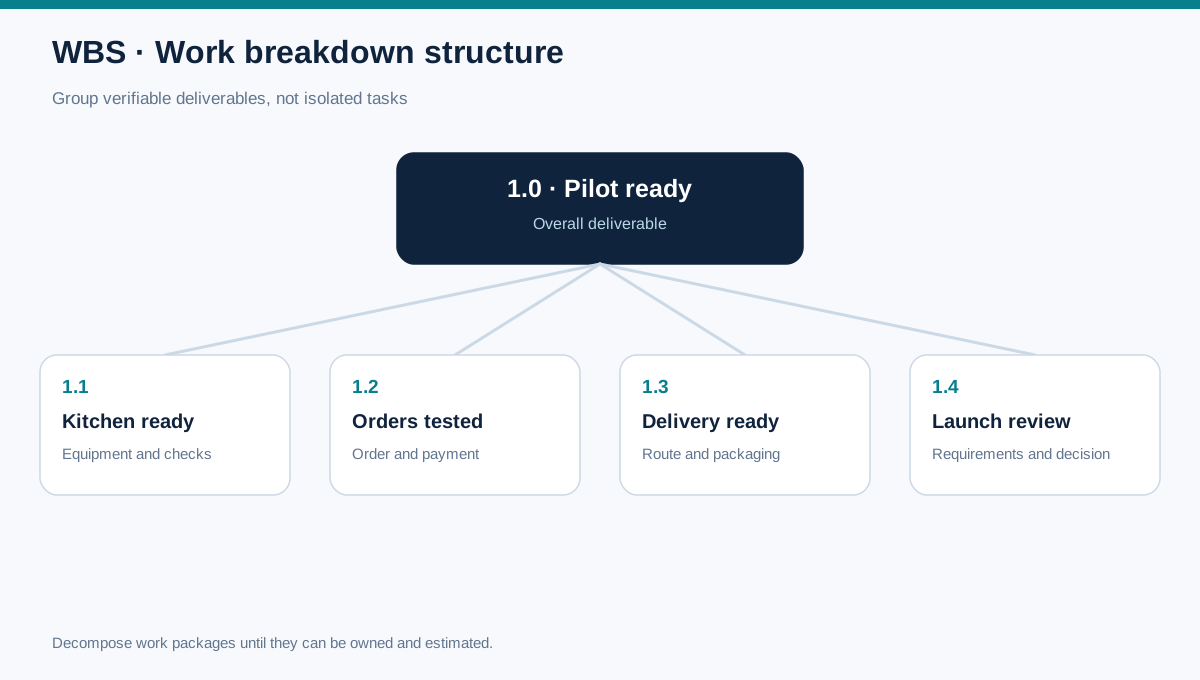
For an Almuerzo Cerca pilot, imagine four major outcomes: kitchen operation ready, order process rehearsed, delivery process ready and launch check completed. Break each into smaller non-overlapping outcomes. “Packaging supplier evaluated” belongs to purchasing; “food temperature check rehearsed” belongs to operations and quality. If two groups independently assume responsibility for ordering the same packaging, resolve that duplication before scheduling.
| WBS code | Deliverable | Included scope |
|---|---|---|
| 1.0 | Pilot prepared | All agreed preparation |
| 1.1 | Kitchen operations ready | Equipment, procedures and applicable controls |
| 1.2 | Ordering and payment tested | Entry, confirmation and rehearsal reconciliation |
| 1.3 | Delivery ready | Route, packaging and owners |
| 1.4 | Opening review completed | Requirements, risks and decision evidence |
Step 2. Decompose until work can be assigned and estimated
Under “delivery ready,” distinguish “suitable packaging assessed,” “pilot route tested” and “exception procedure drafted.” A work package must have an observable outcome, an owner or supplier and an effort that can sensibly be estimated. If “delivery ready” remains impossible to estimate, break it down further; if every package says “call Alex,” the WBS has gone too far into day-to-day tasks.
Build a WBS dictionary. Example: 1.3.2, title “pilot route tested,” description “deliver ten mock orders and log timing,” exclusion “ongoing operation,” acceptance “timing and deviations recorded,” owner and known dependencies. The actual dependencies belong in the activity network.
Step 3. Turn work packages into activities without confusing levels
The deliverable “delivery ready” may require choosing a zone, arranging drivers, preparing mock orders, running a route and examining incidents. These actions have durations, predecessors and resource requirements; they do not replace the deliverable. Give activities IDs linked to their parent package and define evidence of completion.
| Work package | Activity | Evidence |
|---|---|---|
| 1.3.1 Suitable packaging | Compare two samples | Assessment sheet and choice |
| 1.3.2 Tested route | Run rehearsal | Ten recorded delivery times |
| 1.3.3 Exception handling | Write response | Reviewed procedure |
Step 4. Check for missing work and scope drift
Walk through the customer experience from first purchase to delivery and handling a problem. Who cooks, purchases, pays, confirms, checks relevant obligations, fixes failures and authorizes launch? Include items customers never see: documentation, training and testing. Check each item appears only once, and that excluded items have not crept back as hidden activities. Ask the people who will do the work to review the WBS; PMI recommends involving knowledgeable practitioners [R01].
Common mistakes and downstream use
A WBS is not a responsibility matrix, Kanban board or Gantt chart. It cannot answer who, when or in what order without further planning. Use the RACI matrix, duration estimating guide and schedule next. Also avoid treating an assumption about customer demand as a confirmed project deliverable: record the evidence gap.
Worked WBS dictionary: from accepted deliverables to executable work
The 100% rule means that each branch must include all results within its scope, with no duplication or out-of-scope work [R16]. Before scheduling, complete a dictionary for the initial launch. Codes identify results, not sequence; consecutive packages may proceed in parallel.
| Code | Deliverable | Included / excluded | Acceptance evidence | Owner | Derived activities |
|---|---|---|---|---|---|
| 1.1 | Kitchen ready | Equipment installed and tested; no expansion | Throughput test and log | Cook | Inspect, install, test |
| 1.2 | Supplies available | Evaluated supplier and backup; no expanded menu | Verified list and order | Owner | Request, compare, confirm quotes |
| 1.3 | Ordering tested | Manual log and receipt; no mobile app | Order/payment simulation | Owner | Design form, test collection |
| 1.4 | Delivery rehearsed | Pilot packaging and route; no new zones | Ten trial deliveries recorded | Courier | Plan route, test window |
| 1.5 | Staff prepared | Induction and procedures; no second shift | Training record | Owner | Explain, observe, improve |
| 1.6 | Requirements investigated | Authorities and operating conditions | Official evidence where applicable | Advisor / owner | Research, classify, document |
| 1.7 | Financial plan checked | Payments, scenarios, cash gap | Budget and evidenced decision | Owner | Quote, forecast, reconcile |
The dictionary records scope boundaries, acceptance authority, evidence, and open assumptions. “Equipment delivered” is not equivalent to “kitchen ready”: installation, testing, and any applicable requirements remain. Procurement and tests are activities; the accepted kitchen is the deliverable.
If indirect work is absent—supplier coordination, staff training, approvals, incident records—the schedule and budget will be optimistic. For each deliverable ask what must exist for an independent reviewer to accept it; then verify that the same output is not counted in two branches. If a new requirement arises, record its impact and authorize the scope change before altering the baseline. The v2 workbook includes the editable WBSDictionary. Next, use it to assign responsibilities, dependencies, and durations. A WBS does not itself determine dates.
After including that work, cross-check the resource inventory and capability gaps: listing training or coordination in the WBS does not prove the necessary people, hours, or suppliers will be available to perform it.
What you should have when you finish
A complete hierarchy for the current scope, coded work packages, a dictionary with acceptance criteria and a linked activity inventory ready for estimating and sequencing.
Methodological references: [R01], [R16].
Bibliography and references
- [R01] PMI — What Is a Work Breakdown Structure (WBS)?. https://www.pmi.org/blog/work-breakdown-structure
- [R16] PMI — Developing and elaborating effective work breakdown structures. https://www.pmi.org/learning/library/developing-elaborating-work-breakdown-structures-7241