An estimate is not a promise. It is an informed hypothesis about how long work may take, to be improved when evidence arrives.
Effort, duration and waiting time
Effort is the amount of work: for example, six hours to prepare a procedure. Duration is elapsed time from start to finish. If a person can contribute three hours per day, six hours of effort may take two working days; a further five-day approval wait extends the elapsed lead time. Do not confuse hands-on effort with the time an institution or supplier needs to respond.
Before estimating, define the scope, acceptance outcome, available resources, required quality and known conditions. A precise number based on vaguely defined work is false precision, not a better estimate.
Before converting effort hours into working days, check resource availability and capability gaps. A person assigned across several activities can extend the calendar duration even if total hands-on effort stays unchanged.
Where estimates come from
Ask the person doing the work whenever possible; they understand actual tools and constraints. Consult specialists for unfamiliar regulated or technical tasks. Use historical data only when the job is comparable, adjusting for scope, staffing and conditions. Ask suppliers to commit lead times and constraints in writing. PMI recommends input from practitioners and people with comparable experience, with uncertainty documented [R05] [R17].
When lead time depends on third parties, complement the estimate with supplier and partner assessment: verify terms, availability, delivery commitments, and alternatives. An informally stated duration is not a contractual commitment.
| Method | How it works | When it helps | Caveat |
|---|---|---|---|
| Analogous | Compare similar past work | Early estimate | Adjust scope differences |
| Parametric | Units × time per unit | Repeatable work | Rate must be relevant |
| Bottom-up | Estimate components then combine | Divisible complex work | Include coordination and waits |
| Three-point | Optimistic, most likely, pessimistic | High uncertainty | No promised date/probability |
When you have never done the work before
- Define the output and exclusions.
- Break the activity into smaller steps; a small rehearsal may reveal hidden work.
- Find an analogous case and document differences.
- Ask whoever will execute what could change the timeline.
- Separate effort, availability and external waiting.
- Give a justified range, explaining what could cause either end.
- Revisit the estimate after the first real execution.
For novel activities, producing ten trial units may reveal speed, errors and setup requirements. It does not prove that a hundred units will scale linearly; new capacity constraints may appear.
Three-point estimation and PERT without false promises
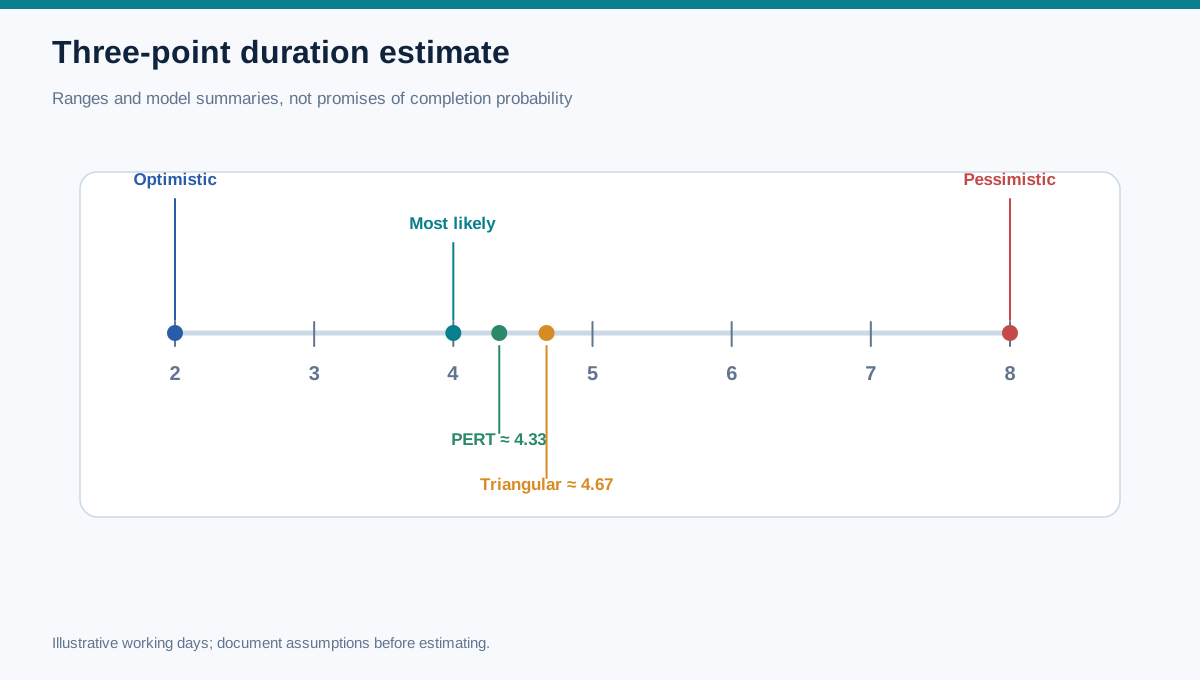
Suppose a process rehearsal could take two days under favorable conditions (optimistic), four days normally (most likely) and eight days under plausible complications (pessimistic). The triangular mean is (2 + 4 + 8) / 3 = 4.67 days. The common PERT approximation is (2 + 4×4 + 8) / 6 = 4.33 days. These are summaries of estimated durations, not evidence that 50%, 73% or 90% of similar tasks will meet either date. Probability statements require distributional and dependency assumptions supported by data; PMI discusses those limitations [R06].
From estimate to schedule
A four-day activity cannot start before necessary people, space, inputs or authorizations are available. Nor is four working days automatically four calendar days. The dependency network defines predecessors; the schedule brings in calendar and resource capacity. Where uncertainty could significantly affect the plan, record a risk and consider a targeted contingency.
Mistakes to catch
Do not demand an exact figure without showing the specialist the work; do not pressure every estimate to fit an already-announced date; and do not add a hidden “30% safety margin” to every task plus a second blanket reserve without understanding double counting. Avoid treating an unimaginable worst case as a normal prediction. Record who estimated, when and with what assumptions.
Traceable estimates: comparing methods and reserves
For unfamiliar work, writing “four days” without a source turns a guess into a false fact. A useful estimate records its method, consulted person or record, scope, estimation date, range, and uncertainty. Analogous estimating compares genuinely similar work; parametric estimating uses known units and productivity; bottom-up estimating combines manageable parts; expert input surfaces missing constraints.
| Activity | Method | Illustrative inputs | Result and limitation |
|---|---|---|---|
| Prepare 30 meals | Parametric | Ten meals per hour, one station | Three productive hours; excludes cleaning |
| Train courier | Bottom-up | Route 1 h + rehearsal 1 h + review 1 h | Three hours of effort, not a promised date |
| Test preparation | Three-point | O=2, M=4, P=8 workdays | Triangular 4.67; PERT 4.33 workdays |
| Receive equipment | Supplier consultation | Hypothetical 3–7 days | External waiting time; verify quote |
The triangular mean is (2+4+8)/3 = 4.67. The PERT approximation is (2+4×4+8)/6 = 4.33. Neither figure alone gives a reliable probability of meeting a date; assumptions about distributions and dependencies would be needed. Do not treat all workdays as continuous labor: record effort, working duration, and external waiting separately.
Where evidence is weak, run a small sample and revise the range instead of adding invented precision. A contingency allowance responds to identified uncertainty and is shown separately from the base estimate, rather than quietly padded into every task. Estimation records three-point inputs; the extended record links to DatedGantt and MasterPlan.
What you should have when you finish
A sheet recording activity, scope, method, source, effort, availability, waiting time, estimated duration or range, uncertainty and review date.
References: [R05], [R06], [R17].
Bibliography and references
- [R05] PMI — Practice Standard for Scheduling — Second Edition. https://www.pmi.org/-/media/pmi/documents/public/pdf/certifications/practice-standard-scheduling.pdf?v=c7ca2721-8c26-4e07-ba47-069d0987bc0c
- [R17] Association for Project Management — 7 common project scheduling mistakes and how to avoid them. https://www.apm.org.uk/blog/7-common-project-scheduling-mistakes-and-how-to-avoid-them/
- [R06] PMI — Project schedule risk analysis. https://www.pmi.org/learning/library/project-schedule-risk-analysis-simulation-4620