A risk does not disappear because it is colored green or red. Assessment helps us understand what might happen and where attention belongs.
Risk, issue, cause and consequence
A risk concerns uncertainty that might affect an objective: “Because we depend on a single supplier (cause), its delivery might be delayed (uncertain event), postponing the trial (consequence).” An issue has already occurred: “The supplier has notified a delay.” A pending assumption—“this supplier usually arrives on time”—may create risks but is not the same thing. ISO 31000 provides principles for identifying, analyzing, evaluating, treating, monitoring and communicating risk in proportion to organizational context [R12].
If the exposure begins with an untested business assumption, see how to prioritize risky hypotheses to decide what to investigate first. Prioritizing a learning question does not replace assessing the consequences of an uncertain event during execution.
Find risks without inventing them
Examine budget assumptions, bottlenecks, dependencies, uncertain requirements, single points of failure, prior experience and conversations with those doing the work. Consider financial, commercial, operational, human, technology, legal and schedule threats. Consider positive opportunities separately where uncertainty could benefit the project. Do not label “we are short of cash” as a future risk when the deficit has already been calculated: that is a present issue; uncertainty about future funding or worsening deficits could be risks.
Likelihood and consequence before color
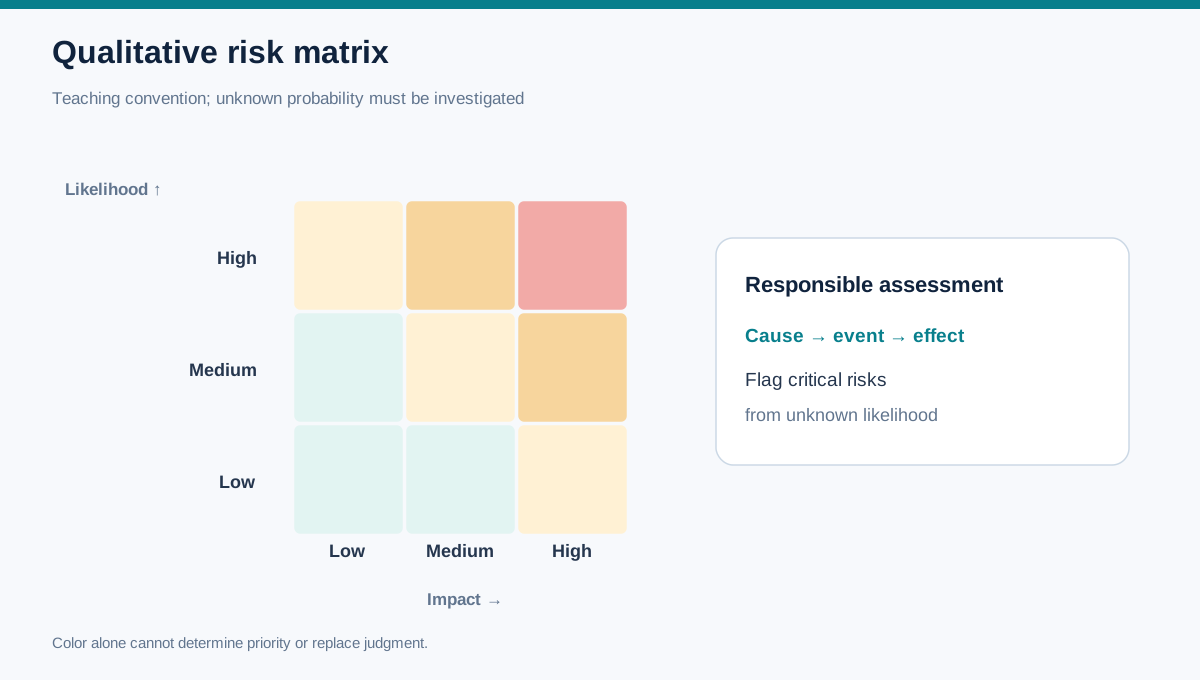
A small project can use a locally defined qualitative scale of low/medium/high likelihood and minor/moderate/severe consequences to timing, money, safety or compliance. Define the categories before using them. A 3×3 colored grid can prioritize attention; it does not calculate mathematical probability.
| Hypothetical risk | Qualitative likelihood | Impact | Next assessment |
|---|---|---|---|
| Late equipment delivery | Medium | High on schedule | Confirm contractual lead time and critical path |
| Faulty sample package | Medium | Low | Evaluate another vendor |
| Unverified legal condition | Unknown | Potentially severe | Research duty before authorizing activity |
| Receipts occur after payments | Medium | High on liquidity | Reforecast monthly cash |
When likelihood is unknown, do not arbitrarily label it high. Investigate first; a serious unresolved exposure may justify a temporary no-go condition meanwhile. A low-likelihood catastrophic event should not be ignored because a color appears reassuring.
A risk-register workflow
- Write cause, uncertain event and effect on an objective.
- Identify whether it affects dates, cost, quality, safety, compliance or reputation.
- Gather evidence and plausible scenarios.
- Make a qualitative or quantitative assessment proportionate to the data.
- Consider proximity, exposed resources and critical-path relationships.
- Assign an owner and priority for further evaluation or treatment.
- Preserve initial evaluation to compare with residual risk after responses.
IEC 31010 helps choose assessment methods appropriate to evidence and circumstances; it does not require a colored matrix for every situation [R13].
Risks that affect dates and money
Suppose uncertain equipment delivery is a predecessor of operations rehearsal in the schedule. It might delay the milestone even with modest likelihood because its impact depends on available float. A late customer receipt may matter more than a comparable increase in sales. Prioritization cannot rely solely on multiplying ordinal scores 1, 2 and 3; that creates an appearance of precision those labels do not possess.
To identify when such a delay creates a shortfall, use the cash-flow and reserves forecast, which places receipts and payments in their respective periods. Rating a risk as “high” does not quantify the cash available to address it.
A risk matrix does not replace judgment
ISO 31000:2018 provides broad risk-management principles and a process [R12]; IEC 31010:2019 guides the selection and application of risk-assessment techniques [R13]. Neither requires one universal color-coded grid. This teaching adaptation defines likelihood (“low,” “medium,” “high”) and impact (“minor,” “major,” “critical”) using explicit case-specific criteria. These words are not disguised numerical probabilities.
| ID | Cause → uncertain event → effect | Likelihood | Impact | Proximity / owner | Reasoned priority |
|---|---|---|---|---|---|
| R1 | Supplier transport issue → late ingredients → delayed rehearsal | Medium | Major | Before testing; owner | High: obtain backup |
| R2 | Unresearched regulated activity → unmet applicable requirement → operation may be blocked | Unknown | Critical | Before launch; owner | Block until established |
| R3 | Order volume exceeds capacity → delivery delay → poor customer experience | Medium | Major | During pilot; courier | Test routes and limit scope |
| R4 | Customer payments arrive late → insufficient cash → obligations unpaid | High in cash example | Major | Month one; owner | Cash and funding plan |
Write every risk as cause, uncertain event, and consequence. A failure that already happened is an issue, not an uncertain future event. Consider upside opportunities when they could affect the decision. A threat with apparently low likelihood but irreversible consequences may warrant urgent treatment regardless of the cell's color.
After choosing a response, record the residual risk and any new risk created by that action. Agree risk tolerance before assigning colors, and revisit it when resources, dates, requirements, or cash change. Institutional references: ISO 31000 and IEC 31010.
What you should have when you finish
A risk register with context, cause, event, consequence, assessment scale, evidence, owner and priority, ready for risk response planning.
References: [R12], [R13], [R04].
Bibliography and references
- [R12] ISO — ISO 31000:2018 — Risk management — Guidelines. https://www.iso.org/standard/31000
- [R13] IEC — IEC 31010:2019 — Risk management — Risk assessment techniques. https://webstore.iec.ch/en/publication/59809
- [R04] Association for Project Management — What is scheduling in project management?. https://www.apm.org.uk/resources/what-is-project-management/what-is-scheduling-in-project-management/