A list of risks without actions, owners and activation criteria is not an executable response plan.
Four responses to threats
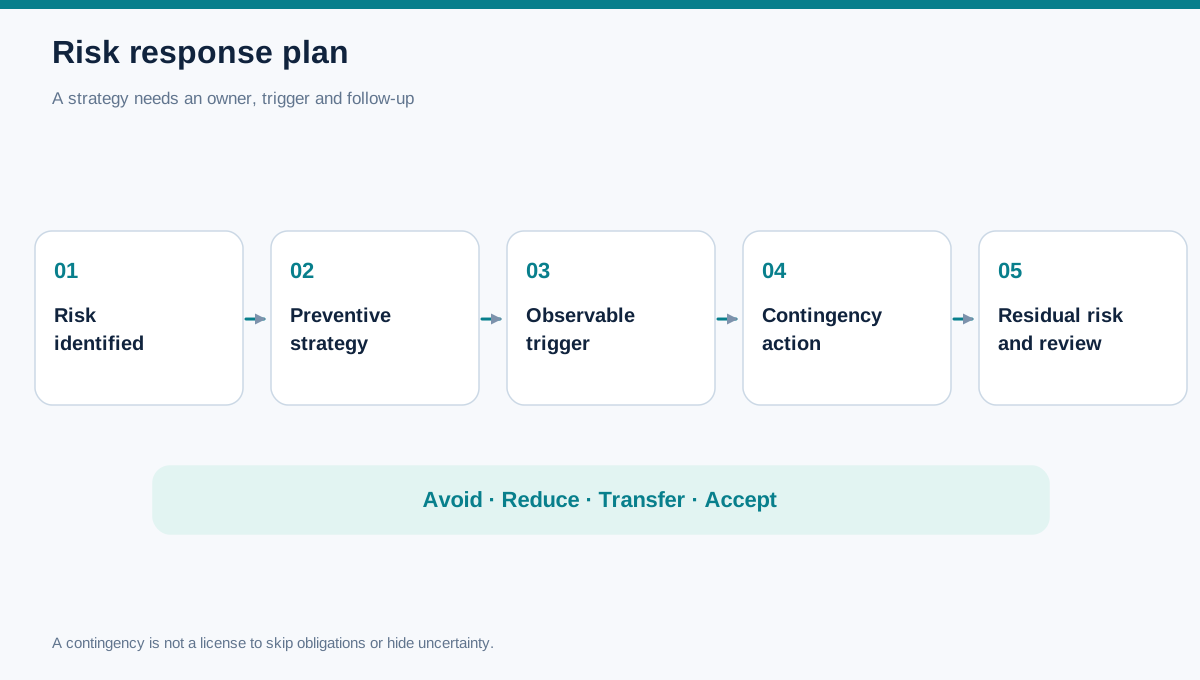
Avoid: change the plan to eliminate the exposure, perhaps removing a specialized piece of equipment from the pilot. Reduce: lower likelihood or consequences, for example preventative maintenance or incoming quality checks. Transfer: move some consequences to another party through contract or insurance without assuming all legal responsibilities disappear. Accept: knowingly retain exposure, monitoring it and planning a response if appropriate. APM discusses these choices and cautions that risk transfer does not necessarily eliminate the risk or its ownership [R14].
Prevention, contingency and recovery
A preventive action happens before an uncertain event to reduce exposure. A trigger is objective evidence that a plan should activate. A contingency says what happens if the event materializes. Recovery aims to restore capacity afterwards. Confirming a supplier's delivery date weekly is monitoring; arranging an alternative supplier is reduction; activating that supplier after a documented missed date is contingency.
If that backup depends on a third party, assess available suppliers and partners before calling it ready: confirm capacity, lead time, terms, and cost. Writing down a name is not proof that the party can respond when the trigger occurs.
Almuerzo Cerca response table
| Risk | Before the event | Trigger | Contingency | Owner |
|---|---|---|---|---|
| Equipment delivery delayed | Confirm timeline and backup | Contractual date missed | Re-sequence tasks or change vendor | Operations |
| Key ingredient unavailable | Assess substitutions | Promised stock unavailable | Adjust menu if safe and viable | Purchasing |
| Liquidity gap | Improve terms and plan reserve | Forecast below minimum cash | Reduce scope, fund or postpone | Founder |
| Launch authorization uncertain | Research and seek advice | No confirmation by decision date | Do not start conditional activity | Compliance owner |
Every response must be feasible, authorized and proportionate to the risk. An action violating applicable duties is not a valid contingency. Changing a menu can also require reassessing ingredients, quality, value promise and compliance.
Estimate time, money and residual exposure
A preventive step costing PEN 300 might avoid a four-working-day delay. Without defensible likelihood estimates, we cannot establish its expected monetary value. We can still assess whether the milestone is critical, whether alternatives exist and what preparing them costs. For significant risks, record response cost, timing, owner, availability and new dependencies. Check the activity network for new critical paths and the cash forecast for additional funding gaps.
After implementation, reassess residual risk (what could still happen) and secondary risk (what the response might create). Adding a second supplier may reduce concentration while introducing inspection work and logistics overhead.
Update the risk assessment matrix, preserving the initial assessment, the response taken, and the exposure that remains. Reducing a threat is not the same as eliminating it; new exposures also need recording.
Reserves and response boundaries
Contingency allowances should correspond to reasonably identified events or scenarios. A management reserve for unknown uncertainty may be controlled separately, depending on governance and scale; neither is a universal “10% for everything.” Do not count the same loss already in a downside cash scenario and again in two reserves. Specify who may approve use, for what amount, at what trigger, and how it is logged.
Record and rehearse the response
Use a risk sheet with identifier, owner, prevention, trigger, response, cost, lead time, contacts, implementation evidence and review date. If a backup is safety-critical, confirm it can be executed with actual resources; a phone number is not proof of capacity. Review roles against the RACI chart and consider the launch decision.
Choose risk treatment by cost, schedule, and residual exposure
The same threat does not always require the same action. For R1—an illustrative late ingredient supplier—we compare four hypothetical choices. The costs and delays are examples, not real supplier quotations:
| Strategy | Trigger / action | Illustrative cost PEN | Schedule effect | Residual risk |
|---|---|---|---|---|
| Accept with monitoring | Up to one-day delay; confirm ETA | 0 | Up to +1 day if rehearsal affected | Medium: delay still possible |
| Reduce | Seek confirmation 72 h ahead and check stocks | 100 | None if successful | Low-medium: transport still uncertain |
| Transfer some consequences | Supplier replacement/penalty agreement | 200 | Immediate delivery not guaranteed | Medium: dependence remains |
| Avoid | Remove menu item requiring this ingredient | 300 | Re-plan pilot scope | Low for that input; new limitations |
Do not conclude that acceptance wins solely because its up-front cost is zero: the effect on the critical path, trust, or cash may be larger. Transferring some consequences through contracts or insurance does not automatically transfer legal obligations or remove operating uncertainty. Prevention aims to avoid the event; a contingency is triggered by evidence; recovery restores operations after a disruption.
An executable plan identifies risk ID, owner, observable trigger, action owner, concrete fallback, estimated cost, funding source, expected delay, residual risk, and escalation threshold. A reserve for this risk must not be counted again in the operating reserve in the cash plan. When the response is triggered, revise the schedule and communicate changes according to the RACI responsibilities [R14] [R18].
What you should have when you finish
An executable response plan with owners, triggers, costs and effects, and a documented assessment of remaining exposure.
References: [R14], [R18], [R12].
Bibliography and references
- [R14] Association for Project Management — Project risk analysis and management. https://www.apm.org.uk/resources/whitepapers/project-risk-analysis-and-management/
- [R18] Association for Project Management — Planning and managing deployment — Competence framework. https://www.apm.org.uk/resources/find-a-resource/competence-framework/overview/planning-managing-deployment/
- [R12] ISO — ISO 31000:2018 — Risk management — Guidelines. https://www.iso.org/standard/31000