A date on a calendar does not certify a business is ready. Evidence that critical conditions are met is what supports a responsible decision.
Finished tasks do not automatically mean readiness
An activity can show “complete” because an application was sent, while the requirement remains pending until the authority confirms what is required. A deliverable may be finished but fail its acceptance criteria. A readiness review therefore checks outcomes, safety, compliance, resources, capability and cash, not merely percentage of tasks completed.
Check cash adequacy with the receipts, payments, and reserves forecast and the minimum balance over the forecast horizon, not just a bank balance on opening day. An approved budget is not proof of cash availability when payments fall due.
A Go / No-Go review is a structured choice: proceed, proceed with limited scope, postpone, fix or stop. It is not a traffic light that replaces judgment or authorizes noncompliance. Conditions come from milestone criteria, the requirements register, the budget and the risk assessment.
Prepare a launch review
- Define the proposed operating model and scope, including limitations.
- List mandatory conditions: verified applicable permissions, safe processes, sufficient capacity, available resources and cash for near-term obligations.
- For each condition, specify evidence and who is competent to check it.
- Categorize as passed with evidence, failed, pending confirmation, or not applicable with reasons.
- Identify important items where an actual workaround or authorized exception is possible.
- Assess residual risk, schedule and minimum projected cash balance.
- Record the decision, reasons, owners and review date.
Initial and expanded review
The complete ten-condition exercise and decision record appear below; the editable worksheet reproduces the same ten conditions.
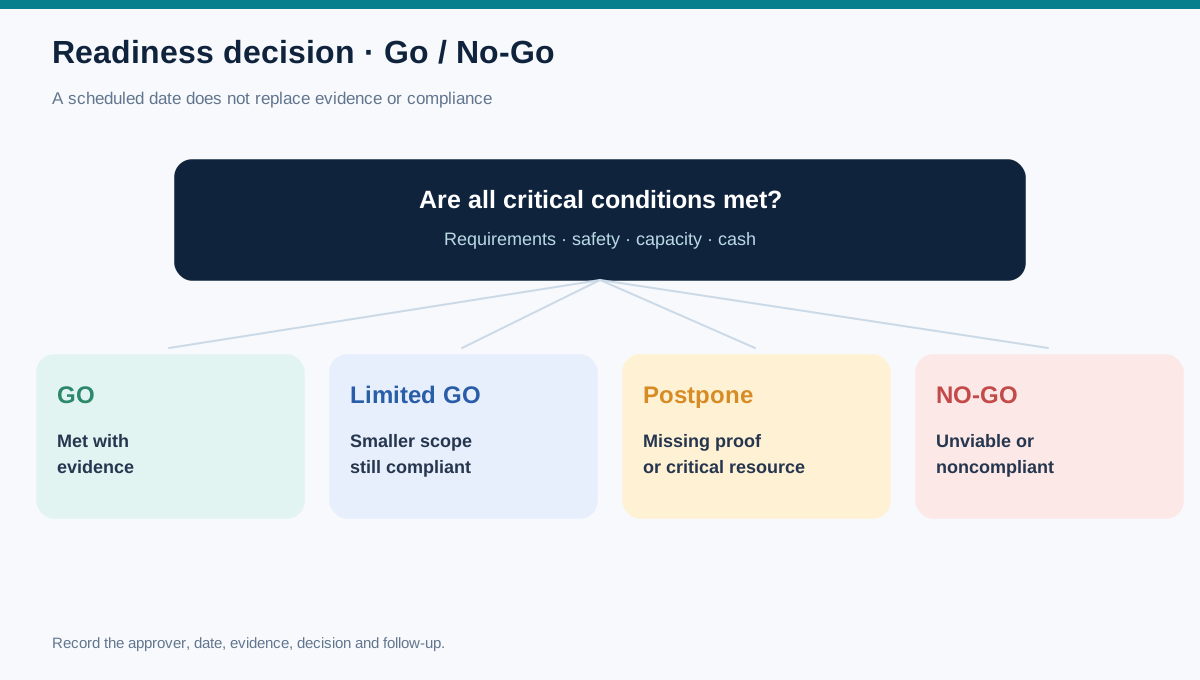
Choose and document the decision
Go: critical evidence has passed and remaining risks meet approved tolerances. Limited Go: a smaller scope still meets all mandatory conditions. Postpone: an essential condition can probably be met, but evidence or resources are not ready. No-Go: the proposed operating model is untenable or would require unacceptable noncompliance. Record approving authority, date, evidence and follow-up. Postponement requires revising the schedule, not preserving a decorative old date.
The pillar 3 decision-tree guide explains decision branches in general; this article applies readiness conditions to an operational launch. A permissible exception might defer a nonessential feature; it must never disregard a mandatory legal condition.
If a nonmandatory exposure is accepted under reduced scope, verify the risk response and contingency plan: it needs an observable trigger, accountable owner, and feasible fallback. Accepting risk never makes a legal prerequisite optional.
Monitoring and operational handover
Approval is not the end of monitoring: appoint owners to watch first-week failures, record incidents, inspect cash and respond to customers. Transfer processes and controls to solution development and subsequent operations. Do not keep an outdated launch checklist as if it were a permanent certificate of availability.
Full ten-condition simulation and Go/No-Go decision record
Readiness is not the number of tasks marked complete: separate condition, evidence, approval authority, and consequence. This exercise does not assert that a particular permit is required; the legal research remains pending and is treated as a potential launch blocker that prevents a claim of compliance.
| ID | Condition | Expected evidence | Fictional status | Blocks launch |
|---|---|---|---|---|
| REQ | Applicable obligations verified | Competent official source/approval | Pending | Yes, if mandatory |
| SEG | Safe preparation tested | Test record | Met | Yes |
| COC | Kitchen throughput demonstrated | Test batch | Met | Yes |
| PER | Team trained | Training record | Met | Yes |
| PRO | Main supplier agreed | Documented terms | Met | Yes |
| ALT | Backup supplier evaluated | Comparable quote | Met | No, if residual risk accepted |
| REP | Delivery window confirmed | Ten trials and times | Pending | Yes |
| PED | Ordering and collection simulated | Error-free record | Met | Yes |
| CAJ | Cash adequate for obligations | Forecast and available funds | Not met | Yes |
| DEC | Decision formally documented | Approved decision record | Pending | Yes before Go |
Illustrative decision record. Scope reviewed: ten-delivery pilot, limited area and two-option menu. Evidence: six conditions met, three pending, one unmet; base month-one closing cash is PEN −1,840 without new funding. Accountable decision-maker: owner. Decision: POSTPONE, not “conditional Go.” Next actions: determine actual jurisdictional obligations, complete the delivery trial, obtain confirmed funding or responsibly reduce commitments, and record a real reassessment date once scheduled.
A limited Go is possible only when a smaller scope still meets every mandatory condition, cash is sufficient, and capacity is evidenced. No-Go applies when the proposed operation remains unviable or its risks unacceptable; Go requires verified critical evidence. Exceptions are possible only for nonmandatory items, with an owner, expiry, and corrective action. The GoNoGo tab lists all ten checks; DecisionRecord captures who decided and why. After approval, hand controls into operations and monitor incidents and cash in the first operating period.
To support that decision, review the resource inventory and capability gaps. Reducing scope may ease the workload, but people, supplies, and available hours must still be sufficient for the proposed pilot.
What you should have when you finish
A readiness checklist with evidence and accountable owners, a Go/No-Go decision record, and actions to proceed, reduce scope, postpone or stop.
References: [R07], [R12], [R11].
Bibliography and references
- [R07] U.S. Small Business Administration — Write your business plan. https://legacy.sba.gov/business-guide/plan-your-business/write-your-business-plan
- [R12] ISO — ISO 31000:2018 — Risk management — Guidelines. https://www.iso.org/standard/31000
- [R11] U.S. Small Business Administration — Apply for licenses and permits. https://legacy.sba.gov/business-guide/launch-your-business/apply-licenses-permits