The useful question is not “what license must every business have?” but “what requirements apply to this activity, in this place and under this exact operating model?”
Legal, regulatory, technical, contractual and operational requirements
A legal or regulatory requirement comes from applicable laws or competent authorities. A contractual requirement arises from an applicable agreement such as a lease. A technical requirement defines a condition of functioning; it may derive from law, contract or an internal quality choice. An operating procedure describes how a requirement is met but is not always mandated by law. Do not confuse a voluntary recommendation, marketing certification and legal permission.
Requirements vary by country, city, industry, goods handled, sales channels, facilities, workforce and customer data processed. The SBA explains this variation in its U.S. business guidance [R11]. The research method can be adapted, but U.S. permits cannot be assumed to apply in Peru or any other country.
Step 1. Describe the activity before searching for rules
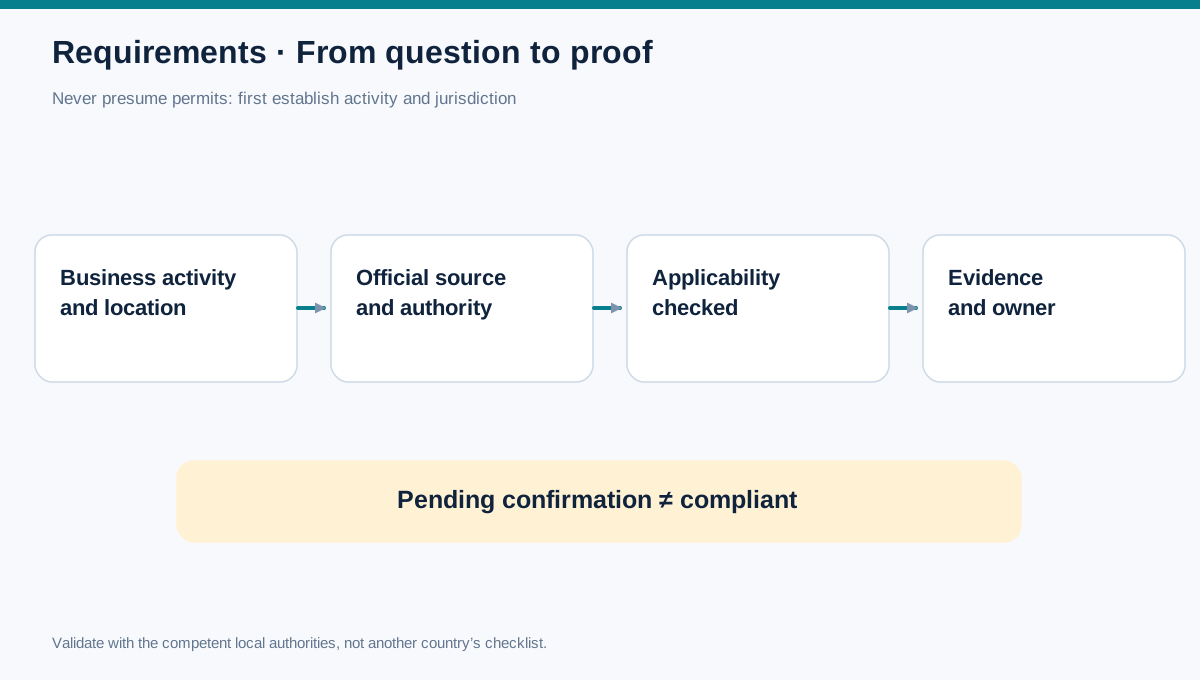
Create a context sheet: primary and secondary activities, place of production and sales, delivery or physical premises, goods and processes, staffing, personal-data processing, contractors and markets served. Operating your own kitchen, using an external kitchen and merely coordinating orders can create different duties. Do not research “restaurant permits” before distinguishing those models.
Step 2. Identify competent authorities and original sources
Start with official business-registration services, tax authorities, municipality or local government, sector regulators and employment or data protection authorities where relevant. Confirm territorial competence and the current version of each rule. A blog can suggest search terms, but the compliance source should be official, or a professional interpretation backed by authoritative references. Retain URL, date checked, applicable excerpt and a contact channel for clarification.
Step 3. Build an evidence-based register
| ID | Requirement to investigate | Source / authority | Evidence | Owner | Status |
|---|---|---|---|---|---|
| REQ-01 | Legal business registration | Competent authority to identify | Applicable certificate | Founder | Verify |
| REQ-02 | Food operating conditions | Sector authority to identify | Approval or inspection if required | Operations | Verify |
| REQ-03 | Customer order information | Official privacy guidance | Policy and controls, if required | Founder | Assess |
| REQ-04 | External vendor obligations | Contract and applicable rules | Agreement and documentation | Procurement | Pending |
This table does not establish that any particular permit applies. “To verify” is intentional. A real register adds regulation and section, jurisdiction, dates, renewal, cost, lead time, dependencies and evidence of completion. If a requirement does not apply, preserve the justification and source.
When compliance evidence depends on a third party, cross-check supplier and partner selection against the required contracts and documents. Choosing a supplier on price alone does not establish contractual or regulatory compliance.
Step 4. Identify genuine legal launch blockers
For each condition ask: must it be met before operating, does it require express permission or only notification/registration, who issues it, what lead time is officially stated, and what preparation can run in parallel? The approval lead time enters the dependency network and becomes a condition in the readiness checklist. Do not mark a condition “compliant” simply because an application was filed or a contractor says “we always do it this way.”
When to seek specialized advice and monitor changes
Ask legal, accounting, technical or food-safety professionals where interpretation involves safety, penalties, personal-data handling or obligations beyond your competence. Request supporting legal grounds and limitations rather than a bare verbal conclusion. Appoint someone to check expiry dates, changes in activity and updated guidance. A renewable authorization needs a date and reminder, not a permanently checked box.
To distinguish who researches a requirement, who prepares evidence, and who is internally accountable for its review, use the RACI matrix. Internal task sign-off cannot replace permission that must come from a competent authority.
Common errors
Never copy compliance lists from another city, assume a digital intermediary has no obligations, treat voluntary certification as a license, or use this article as a substitute for locally applicable advice. Risk assessment helps document the consequences of unresolved compliance, but never excuses a violation.
A traceable requirements register: known versus unknown
There is no universal list of food-business permits without specifying the jurisdiction, premises, actual activity, production model, transport, and sales arrangement. A proper register separates research questions from obligations formally confirmed by a competent authority. SBA guidance explains why activity and location matter, but does not establish Peruvian legal obligations [R11].
| Field | Teaching example | Verification action |
|---|---|---|
| Scope | Prepare and deliver office lunches, area unspecified | Define premises, geography, and model |
| Requirement being investigated | Conditions potentially relevant to food preparation | Search the relevant official portal |
| Authority and legal basis | Not yet identified | Record official URL, rule, section, version |
| Applicability | To be researched, not “compliant” | Check scope and exemptions officially |
| Required evidence | Unconfirmed | Find procedure, decision, or certificate |
| Owner | Founder; specialist support if needed | Log consultation and conclusion |
| Dates | Submission, expiry, renewal not invented | Record only confirmed real dates |
| Effect on release | Blocking if a mandatory prerequisite applies | Link to Go/No-Go |
Separate statutory/regulatory duties, contractual duties, technical requirements, and voluntary standards. Do not label a useful hygiene practice “legally required” without naming the actual law and authority. Equally, treating one practice as optional does not waive any actual duties. Professional legal or food-safety advice may be appropriate where the framework is uncertain.
The editable requirements register should capture source, authority, version, evidence, status, owner, target date, actual expiry/renewal, and the specific operation that would be blocked. If an approval depends on an external party, model its waiting time in the activity network. Until evidence exists, the launch review must not show that condition as met. Track legal changes and use the actual most recent review date.
What you should have when you finish
A business-activity description, authority map, official-source log, verifiable requirements register and list of conditions to confirm before trading.
Bibliography and references
- [R11] U.S. Small Business Administration — Apply for licenses and permits. https://legacy.sba.gov/business-guide/launch-your-business/apply-licenses-permits
- [R07] U.S. Small Business Administration — Write your business plan. https://legacy.sba.gov/business-guide/plan-your-business/write-your-business-plan