Assigning something to “the team” is not clear ownership. Someone must do the work, someone must be able to approve the outcome, and others need to know when to participate.
What RACI is for, and what it cannot replace
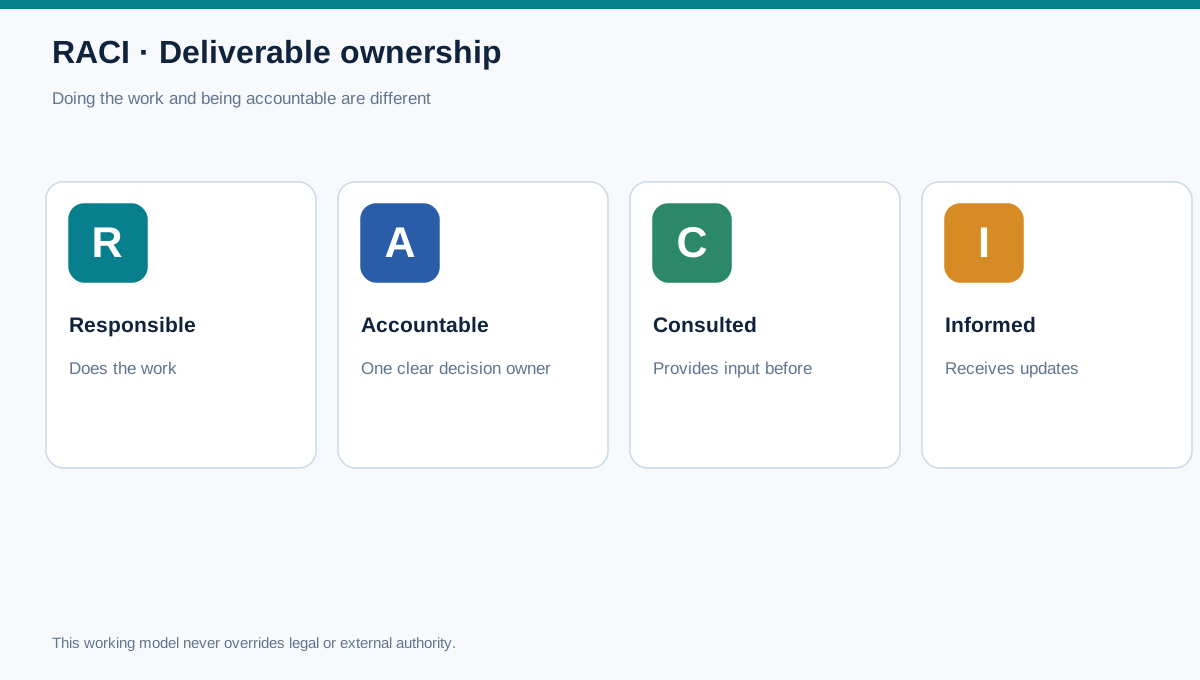
RACI maps significant activities or deliverables to people or roles. R stands for Responsible (does the work), A for Accountable (owns the outcome and normally its approval), C for Consulted (provides input before the work or decision) and I for Informed (receives updates or the outcome). APM discusses it as a way to clarify execution, accountability and communication [R03] [R15]. One person can be both R and A in a small team; several people may carry out the work, but final accountability should remain unambiguous.
Do not use RACI as a substitute for contracts, service-level agreements or legal duties. Nor does a five-minute task need a matrix involving four separate people.
Build the matrix in five steps
1. Select the right rows. Take significant work from the WBS: purchasing, preparation, training, compliance research and trials. Use meaningful decisions or outcomes, not hundreds of tiny tasks.
2. List actual roles. Distinguish owner, cook, courier and external advisor. Do not invent jobs to fill the letters; a solo founder may wear several hats.
3. Assign final ownership first. If two people can independently block or approve the same outcome, clarify decision rules before naming an accountable owner. Then identify who does the work and whose input is necessary.
4. Check capacity. A person marked R on ten deliverables does not automatically have the time to do them all. Cross-check against the resource inventory.
5. Discuss and review. Validate the result with the people named. A RACI chart published without agreement is a diagram, not an execution commitment.
Almuerzo Cerca example
| Outcome | Owner | Cook | Courier | External advisor |
|---|---|---|---|---|
| Select ingredients | A | R | C | I |
| Rehearse preparation | A | R | I | C |
| Research applicable requirements | A/R | C | C | C |
| Approve pilot | A/R | C | C | C |
This chart is illustrative: it does not establish regulatory competence. If an obligation requires a licensed professional or official permission, no internal A can replace it. Specific responsibilities must be checked during compliance research.
If an activity depends on official authorization or a licensed professional, check the legal and operational requirements guide before assigning sign-off. An A identifies internal accountability; it does not make the person a regulatory authority.
Resolving conflicts and special cases
No R means no designated executor. No A means unclear sign-off. Consulting everyone about every activity may slow decisions. If the founder is A for every operational choice, reconsider the decision design. With external suppliers, RACI complements rather than replaces their contracts. For a one-person business, a simple table of “activity / owner / adviser / evidence” may suffice.
Review departures, absences and new hires. Link owners to dates in the schedule and to final approvals in the readiness review.
If the absence of a critical person would stop a deliverable, connect that dependency to risk responses and contingency plans. Define who can step in, when the alternative is triggered, and which approvals still apply, without treating every absence as requiring a formal contingency plan.
Extended exercise: four real roles and unmistakable approval
The scenario requires an owner, cook, courier, and external advisor. A supply vendor matters but is not a substitute for the courier in a team responsibility chart. Ask two distinct questions about every result: who produces acceptance evidence (R) and who is accountable for accepting the result (A). One person may hold both roles in a small team.
| Deliverable / decision | Owner | Cook | Courier | External advisor |
|---|---|---|---|---|
| Select supplies | A | R | C | I |
| Test preparation | A | R | I | C |
| Test delivery window | A | C | R | I |
| Investigate applicable requirements | A/R | C | C | C |
| Approve limited pilot | A/R | C | C | C |
Mistake 1: assigning everybody an “A” on one approval leaves decision authority ambiguous. Correction: one accountable internal approver with clear consultation rules. Mistake 2: leaving delivery without an “R” because a third party is involved. Correction: specify execution and verification duties in the service agreement. Mistake 3: treating the external advisor as the regulatory authority: professional advice does not replace formal approval where required.
A solo business may use “owner / support / evidence” instead of a full matrix. With several people, assess absence and over-allocation: an owner assigned to every task may have no time left to review outcomes. Compare commitments with resource capacity and the schedule. The v2 workbook corrects the original vendor column to courier and provides an editable matrix.
What you should have when you finish
A readable matrix for major outcomes, a clear final approver where needed, and realistic agreement on who executes, is consulted and receives information.
Methodological references: [R03], [R15].
Bibliography and references
- [R03] Association for Project Management — The Grapes of Wrath and Kafka: Why RACI is important. https://www.apm.org.uk/blog/the-grapes-of-wrath-and-kafka-why-raci-is-important/
- [R15] Association for Project Management — Take Responsibility — Stakeholder engagement. https://www.apm.org.uk/resources/find-a-resource/stakeholder-engagement/key-principles/take-responsibility/