A milestone is not evidence that “we worked hard.” It is an important condition that someone else can check without relying on the doer's opinion.
Objective, activity, deliverable and milestone
Objective: make a controlled first operation possible. Activity: interview suppliers. Deliverable: comparative supplier assessment. Milestone: supplier selected with documented requirements and terms. Acceptance criterion: a specific rule for confirming an outcome, for example inspected samples and documented lead time. A milestone is usually a control point, not a task that takes several days.
The parent article's phrase “verifiable milestone” means an outcome defined well enough that another person can determine whether it has been achieved. This does not call for bureaucratic certification of every small improvement.
Writing a useful milestone
Start with the result, bound its scope and specify evidence. “Kitchen ready” is ambiguous. “Kitchen equipped, cleaning procedure rehearsed and applicable operating conditions confirmed for the chosen activity” is checkable. Record the estimated target date, approving owner, evidence and dependencies. If an authority must grant permission, filing an application is not the same as obtaining approval.
When several roles are involved, use the RACI matrix to distinguish who produces the milestone evidence from who has internal authority to accept it. Naming an executor is not the same as assigning final approval.
To identify the relevant authority, what evidence constitutes actual authorization, and what remains open, see how to research and record legal and operational requirements for the actual activity and jurisdiction. Internal milestone sign-off cannot replace external permission.
| Item | Weak wording | Checkable milestone |
|---|---|---|
| Supplier | Look for packaging | Two candidates assessed and one chosen |
| Preparation | Fix kitchen | Installation checked and applicable requirements confirmed |
| Sales | Create form | Test order and payment successfully processed |
From “everything matters” to MoSCoW
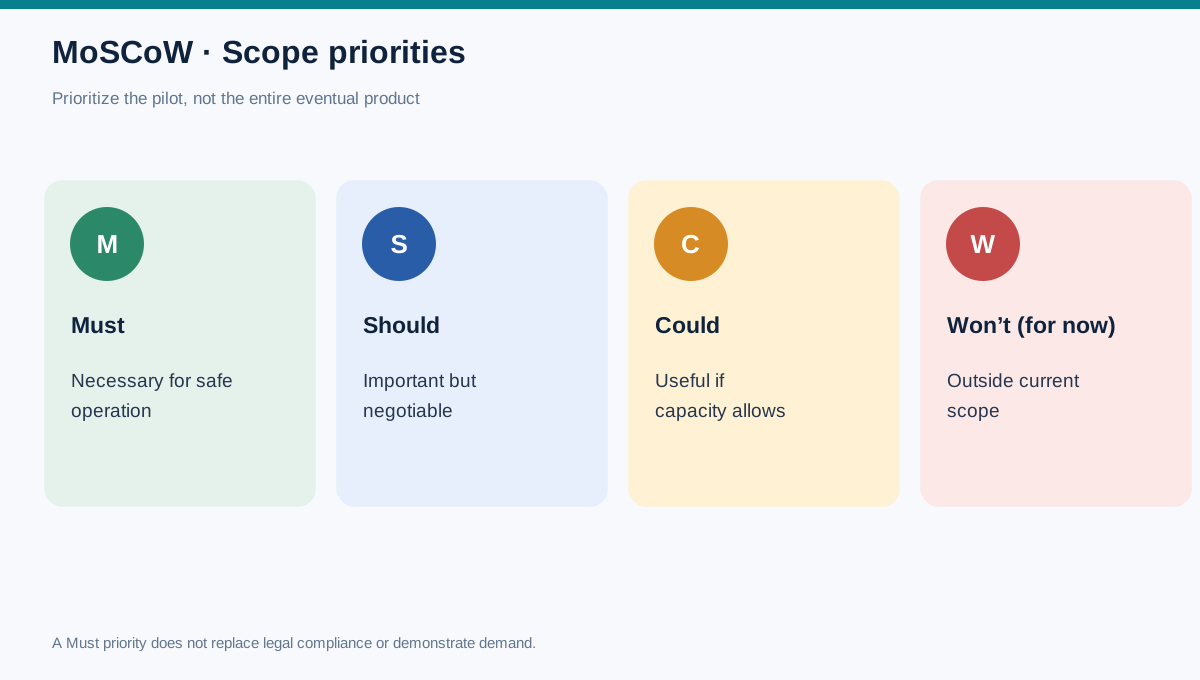
MoSCoW divides the scope for a defined period into Must Have (essential now), Should Have (important but a workable alternative exists), Could Have (nice if capacity remains) and Won't Have this time (explicitly excluded). It must be applied to a specific release or period, not to the permanent importance of a feature. Agile Business Consortium documents the technique in the DSDM context [R02].
For Almuerzo Cerca, satisfying applicable obligations and safely handling food are launch conditions, not optional features. A custom ordering app might be a Could if a manual process can work. Personalized recommendations can be Won't. If the business drops a legally required condition to meet its budget, that is not valid prioritization: it must change its operating model or postpone launch.
A practical initial-scope exercise
- List results needed to fulfill the core promise without compromising safety or legality.
- For each, ask: if this is absent, can we responsibly start with an actual alternative? If not, it is a potential Must.
- Examine hidden dependencies: a manual workaround may still need training and controls.
- Distinguish team preference from demonstrated customer needs; a visual preference seldom blocks a pilot.
- Record exclusions so they cannot return unnoticed and change cost or date.
- Compare the scope with the startup budget, dependencies and available resources.
Acceptance and change control
For every important milestone define testable acceptance: a trial, log, official document, inspection result or approval. Distinguish operational-readiness evidence from demand evidence. Producing 30 lunches in a rehearsal demonstrates a capacity under those conditions; it does not show that 30 customers will buy daily. Demand requires separate experiments.
When funding is tight, reconsider the Should and Could items; if a Must cannot be met, revise the authorized scope or date. Maintain a baseline and record the proposer, reason, impact and approval for changes.
Worked MoSCoW matrix and scope baseline
Must Have does not mean “the founder wants it”; it means that launching would be unviable, unsafe, or unlawful without it. Ask: if this is missing, is there a legitimate workaround that still makes the release viable? MoSCoW priorities are assigned for this pilot, not for all future releases [R02].
| Item | Pilot category | If missing | Workaround / decision |
|---|---|---|---|
| Applicable compliance confirmed | Must | Operations may be prohibited | No substitute for a mandatory rule |
| Safe preparation tested | Must | Unacceptable risk | Do not launch without evidence |
| Traceable orders and receipts | Must | Orders/payments can be lost | A tested manual form is acceptable |
| Optimized in-house delivery | Should | Timeliness may suffer | Restrict area and volume |
| Five-option menu | Could | Less choice | Offer two core options |
| Ordering mobile app | Won't this time | Manual pilot remains viable | Explicitly postpone |
In this exercise, milestone HIT-01 is “ten documented trial deliveries”; its acceptance criterion is ten complete records with times, status, and observations, reviewed by the accountable owner. “Rehearse delivery” is an activity, not a verifiable milestone. HIT-02 is an approved Go/No-Go record: evidence, blockers, decision, authority, and actual decision date.
Scope baseline v1 covers the kitchen, supplies, manual ordering, staff, pilot delivery, and requirement checks; it excludes new delivery areas and an app. When resources are constrained, reduce Should/Could scope or volume—never make an applicable legal or safety requirement optional. For an exception, record approver, boundaries, and review date. The v2 workbook's MoSCoW tab supports editable categories, rationale, and workarounds; Milestones tracks acceptance evidence.
What you should have when you finish
A milestone sheet, objective acceptance criteria, MoSCoW table and explicit exclusions, connected to launch-readiness checks.
Methodological references: [R02], [R01].
Bibliography and references
- [R02] Agile Business Consortium — What is MoSCoW Prioritization?. https://www.agilebusiness.org/resource/what-is-moscow-prioritization/
- [R01] PMI — What Is a Work Breakdown Structure (WBS)?. https://www.pmi.org/blog/work-breakdown-structure