Getting started costs more than buying equipment: it involves pre-opening payments, operating conditions and the cash needed before customers pay.
Investment, expense, cost and cash outflow
In everyday language, “initial investment” often describes all money needed to start. For a useful budget, distinguish assets (equipment or facilities that may provide value over future periods), preparation (fit-out, trials, advice), initial inventory, recurring operating expenses and reserves. Accounting recognition of assets, costs and expenses follows specific rules: do not assume every initial purchase is automatically an immediately deductible expense. A cash outflow occurs when payment is actually made, which may differ from the period when an expense is recognized.
The SBA recommends estimating one-time and monthly startup costs separately [R08]. For how costs relate to prices and contribution margins, refer to the business economics guide; that answers a different question.
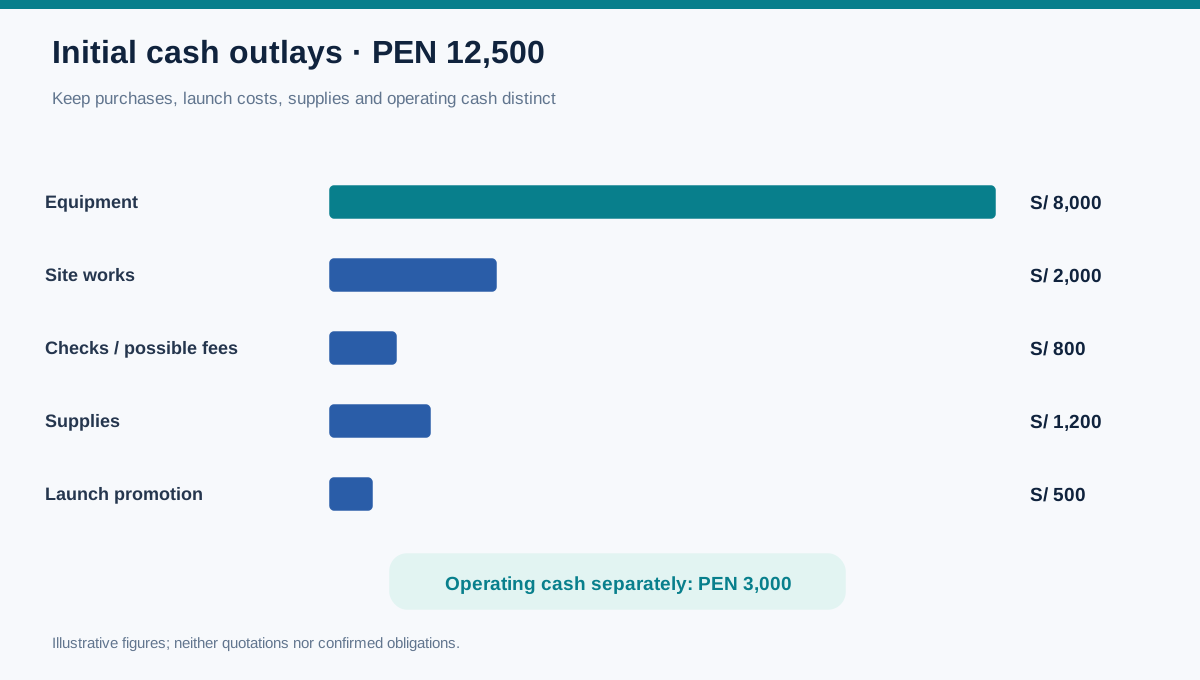
Inventory payments by category
Begin with the WBS and resource gap inventory. Record required quantity, unit price, applicable tax or fees, transport, setup, estimated payment date, vendor and confidence level. Ask for comparable quotes: two machines with different capacity, warranties and delivery terms are not equivalent merely because their sticker prices match.
To compare those offers beyond the sticker price, use supplier and partner selection criteria: check terms, lead times, delivery capacity, and fallback options. The lowest quotation is not automatically the lowest total startup cost.
| Illustrative category | PEN | Nature |
|---|---|---|
| Kitchen equipment | 8,000 | Asset purchase, accounting treatment to confirm |
| Facility preparation | 2,000 | Pre-opening payment |
| Assessments, training and possible paperwork | 800 | Estimate; requirements not verified |
| Initial ingredients | 1,200 | Initial inventory |
| Initial communications | 500 | Marketing preparation |
| Total initial payments | 12,500 | Excludes operating cash and contingency |
Figures are hypothetical, not local market prices for any city. The parent pillar's example included PEN 8,000 for equipment, PEN 2,000 for improvements and PEN 3,000 for initial operating support. We preserve the first two, and treat PEN 3,000 as opening operating cash in the cash flow forecast, not as an extra expense or proof of sufficiency.
Estimate unknown expenses without inventing precision
Use dated quotes for known purchases; ranges with documented sources for uncertain items. For permits or authorizations, research official charges and published timelines within the selected jurisdiction, without inventing universal requirements. If a machine needs delivery and installation, show those as separate lines or note that they are included. An unconfirmed item is “to verify,” never automatically zero.
To turn possible fees or filing costs into supported budget lines, follow legal and operating requirements research for the actual activity and jurisdiction. Do not assume that every permit mentioned in another country applies to this business.
From startup payments to funding need
The PEN 12,500 of initial disbursements is not automatically “all the money required.” Add cash needed before receipts and justified coverage for uncertainty; subtract available founder funds without implying personal expenses can be ignored. Each amount should be counted once. One useful relationship is:
Total cash required = initial payments + worst forecast operating shortfall + justified reserve − committed available funds, adjusting for timing and not adding elements already contained in opening cash balance.
The actual amount depends on the cash forecast, not a universal contingency percentage. Do not purchase six months of perishable inventory for a pilot that only needs a small starting quantity.
Version control and common mistakes
Include vendor, date, currency, assumption and tax treatment. Avoid counting a full recurring monthly cost as a startup payment and then again in the first month's cash outflow. A refundable deposit is not the same as a nonrefundable expense. Separate order, invoice and payment dates. Consult a qualified accountant for real treatment.
Itemized budget: quantity, evidence, and payment calendar
A single total is not enough to manage procurement. For each item record quantity, unit cost, applicable freight or taxes, quotation source, currency, inquiry date, and expected payment date. Every amount below is an instructional assumption, not a verified market quotation.
| Line item | Units | Unit price PEN | Payment PEN | Illustrative date | Nature |
|---|---|---|---|---|---|
| Equipment | 2 | 4,000 | 8,000 | Dec 1, 2026 | Asset, subject to accounting rules |
| Fit-out | 1 | 2,000 | 2,000 | Dec 2, 2026 | Pre-opening |
| Checks and filings | 2 | 400 | 800 | Dec 3, 2026 | Jurisdiction dependent |
| Initial supplies | 3 batches | 400 | 1,200 | Dec 4, 2026 | Opening inventory |
| Tests and training | 2 | 250 | 500 | Dec 5, 2026 | Pre-opening |
| Total payments | 12,500 |
Do not double-count startup payments as first-month operating payments. If the PEN 1,200 of opening inventory has already been paid, separately track consumption and later replenishment; do not record the same cash disbursement twice. Verify whether quoted amounts include freight and taxes. Financial-statement expense recognition and cash payment are not identical and depend on the relevant accounting treatment.
The PEN 3,000 opening cash is an available balance, not another expense: this example requires PEN 12,500 of payments plus PEN 3,000 of initial operating cash, or PEN 15,500 of funds available before trading. That still does not prove ongoing liquidity; the cash forecast must test later shortfalls and funding must respond to evidenced needs.
When a quotation changes, retain supplier, version, and impact on cash and schedule. The v2 Investment sheet includes units, unit prices, formula-driven totals, sources, conditions, and payment timing. The dates are not commercial commitments.
What you should have when you finish
An auditable startup budget with categories, sources, payment dates, confirmation states and alternatives, connected to cash-flow planning and funding choices.
Bibliography and references
- [R08] U.S. Small Business Administration — Calculate your startup costs. https://legacy.sba.gov/business-guide/plan-your-business/calculate-your-startup-costs
- [R09] Australian Government — business.gov.au — Set up a cash flow statement. https://business.gov.au/finance/cash-flow/set-up-a-cash-flow-statement