Not every uncertainty deserves immediate attention. If an app looks unappealing, we may need to improve it; if no customer would pay enough to sustain it, we may need a different business model. Prioritizing hypotheses means learning first where being wrong would be most costly, not where asking questions is easiest [R01][R02].
Four questions before setting priorities
- Impact: if the claim is false, does the opportunity disappear, or is a small adjustment enough?
- Uncertainty: what evidence exists, and how relevant is it?
- Timing and commitment: are we about to invest, promise, or contract based on this belief?
- Dependencies: does another decision rely on this answer, or is there something we must learn first?
Risk and uncertainty are not synonyms: risk includes consequences, while uncertainty concerns what we do not know. A claim may be poorly studied yet unimportant, or essential but already well supported.
Map importance against uncertainty
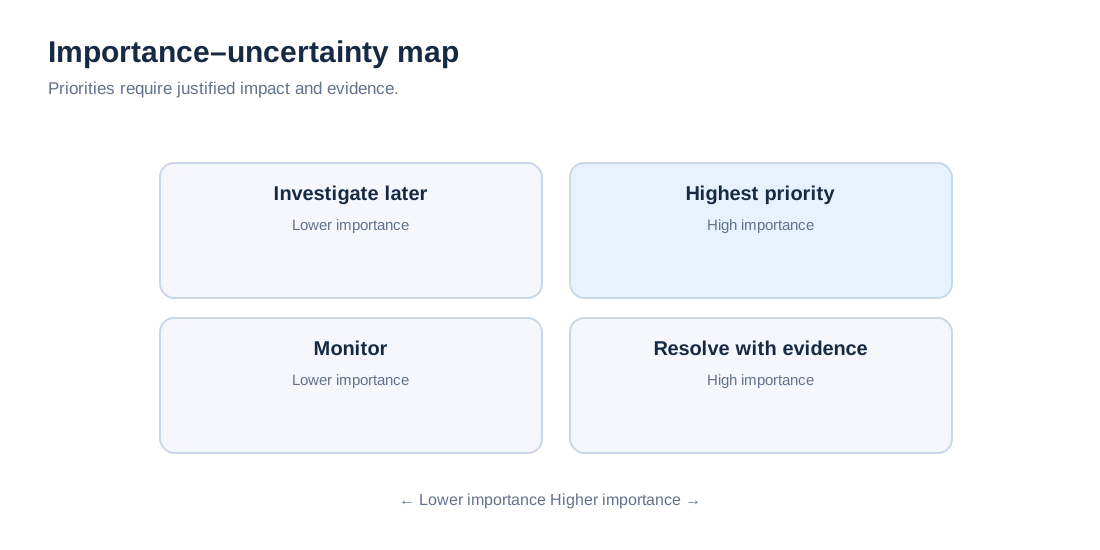
Strategyzer's Assumptions Mapping identifies critical claims by considering importance and evidence [R01]. Draw a matrix with two axes: less/more important and weaker/stronger evidence. Important unsupported claims deserve particular attention. Do not treat its quadrants as calculated probabilities.
An optional score can multiply impact from 1 to 5 by uncertainty from 1 to 5. This is an illustrative editorial tool, not a universal statistical formula. Explain each rating; otherwise the number merely hides an opinion.
Before scoring the evidence, see how to assess sources, biases, and alternative explanations. Many similar answers may still be weak evidence if they share the same selection bias.
| Booking-service hypothesis | Impact 1–5 | Uncertainty 1–5 | Illustrative priority |
|---|---|---|---|
| Restaurants will pay a monthly fee | 5 | 5 | 25 |
| A team can support ten restaurants | 4 | 4 | 16 |
| Managers prefer a blue background | 1 | 4 | 4 |
| Demand exists in a second neighborhood | 3 | 5 | 15 |
These scores are invented for practice. A different team might legitimately rate them differently; making the reasoning visible is what matters.
Add dependencies and the cost of being wrong
Before investing in automation, we may need to establish whether a manual workflow solves the problem. Before marketing an annual subscription, investigate whether recurring usage is sensible. Draw precedence links between hypotheses: some can be researched in parallel; others depend on earlier findings.
Prioritizing a hypothesis differs from prioritizing an experiment. A critical question may require an expensive test. You can start with a cheap signal to decide whether the next test is worthwhile, without mistaking that signal for adequate validation. Use the experiment selection guide for this second decision.
A critical assumption may depend on resources, third-party deliveries, or approvals that cannot all be tested at once. The dependency and critical-path guide separates necessary sequences from work that can genuinely proceed in parallel, including the cost of testing in the wrong order.
When to investigate, assume provisionally, or stop
Investigate first when findings could change an imminent investment. Record a temporary assumption if impact is low and proceeding with monitoring is reasonable. Stop or redesign when an essential condition repeatedly conflicts with technical, financial, or ethical constraints. Unfavorable evidence does not always require abandoning everything: another segment or business configuration might work.
A backlog of risks, not features
Each row should capture an ID, risk dimension, claim, importance, present evidence, uncertainty, blocked decision, owner, and next action. Include a review date. When an experiment ends, do not erase the hypothesis; update evidence and decisions. Subsequent cycles feed the Design–Test Loop.
Exercise: take three desirability, feasibility, and viability hypotheses. Score them with explanations, then select the first one whose failure would force a business redesign. Do not reward a test merely because the team already knows how to run it.
What you should have by the end: a risk map and prioritized sequence of critical hypotheses with documented dependencies. Main sources: [R01], [R02], [R04].
Bibliography and references
- [R01] Strategyzer. How Assumptions Mapping Can Focus Your Teams on Running Experiments That Matter. https://www.strategyzer.com/library/how-assumptions-mapping-can-focus-your-teams-on-running-experiments-that-matter — Tipos de hipótesis, mapa de supuestos, riesgo.
- [R02] Strategyzer. How To Test Your Idea: Start With The Most Critical Hypotheses. https://www.strategyzer.com/library/how-to-test-your-idea-start-with-the-most-critical-hypotheses — Hipótesis críticas y secuencia de experimentación.
- [R04] Strategyzer. The Experiment Library. https://www.strategyzer.com/library/experiment-library — Selección de pruebas por costo, preparación, duración y evidencia.