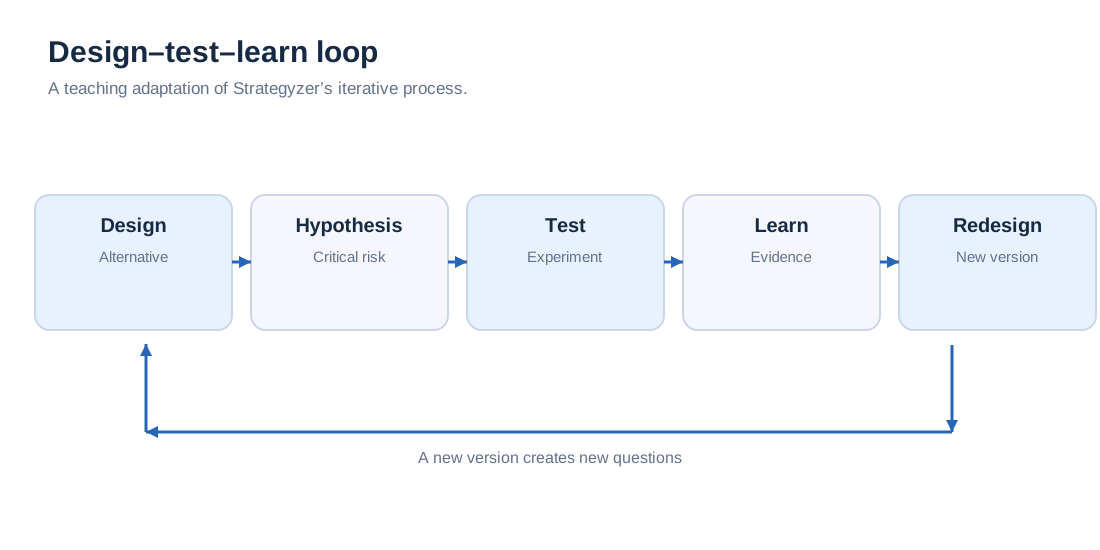
Iteration does not mean repeating the same thing until the result looks good. It means deliberately changing an idea, hypothesis, or test in response to learning and gathering evidence again. Strategyzer describes a loop between designing alternatives and testing their assumptions—the Design–Test Loop. The search continues while important risks remain unresolved [R06][R21].
Two connected activities: designing and testing
In design, we imagine and modify the value proposition, business model, service, and delivery structure. In testing, we articulate hypotheses, select experiments, observe results, and learn. A test may lead us to redesign the offer; the redesigned model may create new unknowns. Teams do not need to follow a perfect circle or always restart at step one.
Repeating is not the same as iterating
Repeating an identical test may establish consistency or improve precision. Iterating means making a documented change to something the evidence challenged: price, segment, flow, promise, channel, metric, or procedure. Changing everything at once makes attribution difficult. If several dimensions must change, document which questions remain unresolved.
Before starting another test, revisit how to choose an experiment for the new question. The previous method may no longer fit if the hypothesis has changed; the next test should produce evidence relevant to the decision now at stake.
Decisions generated by learning
- Persevere: evidence supports a bounded next commitment.
- Adjust: part of the offering or process needs improvement without changing the core premise.
- Pivot: a central hypothesis changes, such as the segment or revenue mechanism.
- Repeat or extend the test: results remain inconclusive or measurement uncertainty is still high.
- Pause or stop: risk, lack of viability, or obligations no longer justify additional investment.
These labels do not replace a recorded decision in a decision tree.
Three iterations of a booking service
Iteration 1 — Understand the workflow. Some venues appear to lose time confirming reservations. A wireframe trial shows managers do not understand how to change times. Decision: simplify the flow. There is no payment evidence.
Iteration 2 — Rehearse delivery. A hypothetical free pilot is offered to ten eligible restaurants: six accept, five activate, and two remain active at day fourteen. Redundant alerts and extra work appear. Decision: reduce notifications and test again with a comparable group, recording the change. These figures do not describe the market.
Iteration 3 — Examine economics and commitment. After use improves, investigate acceptable payment terms and estimate the actual support cost. If cost per client exceeds expected contribution, revisit the revenue model rather than celebrating visual improvements. Third-iteration outcomes remain hypothetical assumptions until measured.
Update artifacts without losing history
After each cycle, update the Business Model Canvas when a design decision changes; update the hypothesis backlog when priorities shift; create a new Test Card for the next test; and record findings on the Learning Card. Preserve versions: V1 original claim, V2 modification, evidence behind the modification, and date.
To keep an auditable trail across cycles, use the guide to objective experiment documentation: preserve protocols, events, incidents, and learnings separately from later interpretations. A new version should not erase unfavorable findings.
| Version | What we learned | What changed | What remains to be tested |
|---|---|---|---|
| V1 | Staff struggle with the flow | Simplified changing booking times | Repeat use |
| V2 | Some activated users drop out | Reduced duplicate alerts | Persistence and causes |
| V3 | The economics remain uncertain | Designed payment and support trial | Real price and costs |
When should experimentation stop?
There is no fixed number of iterations. Move forward when unknowns affecting the next decision have sufficient support, with clear limits. If a new test would change no action, further learning may not justify its cost. If an essential condition fails repeatedly, reconsider the model or stop. The goal is not to prove that the business is perfect but to commit resources with better knowledge [R06].
Return to the right pillar
If the need changes, return to opportunity discovery. If charging changes, revisit business model design. If a different representation is needed, use prototypes for testing. Iteration crosses stages; it does not replace future development or operations.
What you should have by the end: a record of three linked cycles, decisions, evidence, and new hypotheses without losing prior versions. Main sources: [R06], [R21], [R03], [R05].
Bibliography and references
- [R06] Strategyzer. How to design and test business ideas. https://www.strategyzer.com/library/the-role-of-an-effective-innovation-coach — Design–Test Loop, pivotar, perseverar o abandonar.
- [R21] Strategyzer. Search = Design, Test, Learn, and Iterate. https://www.strategyzer.com/library/search-design-test-learn-iterate — Iteración entre diseño y experimentación.
- [R03] Strategyzer. Validate Your Ideas with The Test Card. https://www.strategyzer.com/library/validate-your-ideas-with-the-test-card — Hipótesis, prueba, métrica y umbral.
- [R05] Strategyzer. Capture (Customer) Insights and Actions with the Learning Card. https://www.strategyzer.com/library/capture-customer-insights-and-actions-with-the-learning-card — Resultados, aprendizaje y acciones.