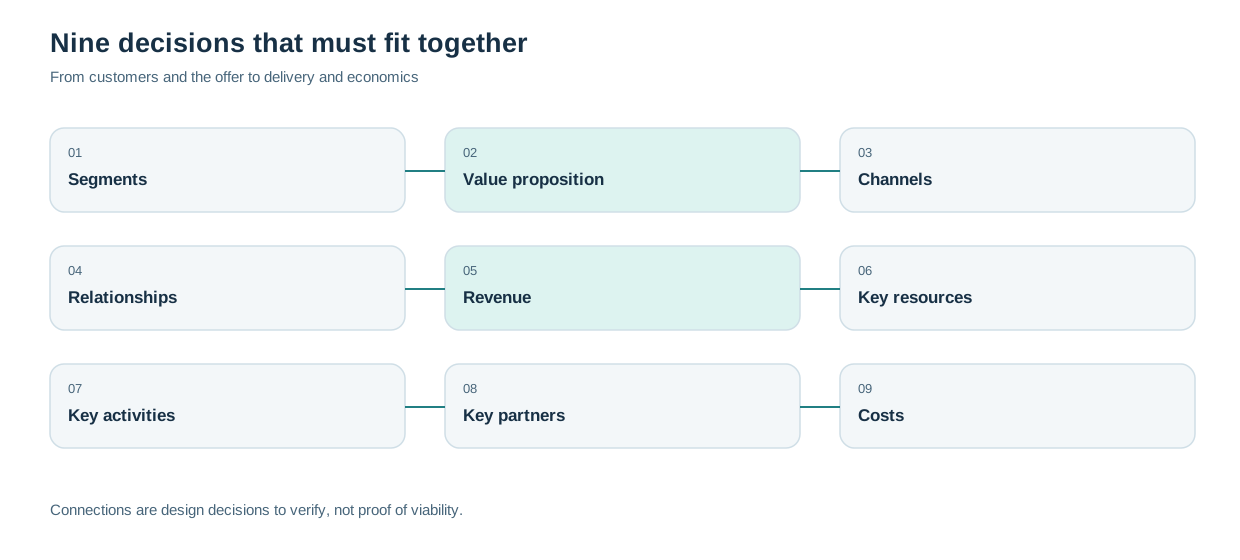
The Business Model Canvas (BMC) represents nine interdependent decisions about creating, delivering, and capturing value on one page. It was developed by Alexander Osterwalder and collaborators and popularized by Strategyzer. It does not prove that a business works: it is a representation for comparing possibilities, finding contradictions, and raising questions [R01][R02].
The nine blocks and the question each one answers
| Block | Question to answer without empty slogans |
|---|---|
| Customer segments | Which specific group has the need, and who pays? |
| Value propositions | What meaningful improvement does the group receive? |
| Channels | How do customers discover, evaluate, buy, and receive the offer? |
| Customer relationships | What kind of interaction and support do they need? |
| Revenue streams | What is charged for, how much, when, and per what unit? |
| Key resources | Which assets and capabilities make the offer possible? |
| Key activities | Which essential work must we do well? |
| Key partners | Who helps deliver value, and whom do we depend on? |
| Cost structure | What are the main costs of the system? |
These nine blocks are part of the original tool [R01]. The workflow below is a practical sequence, not the only correct sequence for filling it in.
Step 1. Define one model and one version
Record the date, owner, main segment, offer under consideration, and geographic scope. If you operate two businesses with different logics, do not hide both in one confusing Canvas. Keep old versions to understand why your decisions changed. Use business model types to decide which alternative you are mapping.
Step 2. Start with customers and value
Name a specific segment, not “everyone.” Connect that group to an outcome it values and evidence of investigated needs. The proposition must describe more than technology or ingredients: it should describe a meaningful change for the person. See prioritizing needs and building a value proposition.
Step 3. Design channels and relationships
Separate how people discover the business, how they purchase, and how the product reaches them. Then indicate who answers questions, how new customers get started, and what happens after purchase. A cheap channel can require expensive support. Cross-check sustainable channels and the customer journey.
Step 4. Describe the money and the system behind the promise
Define the billing unit and frequency. Separate fixed from variable costs. Identify resources, activities, dependencies, and partners needed to deliver the promise. Explicitly flag conditions that remain hypotheses. Connect with business economics, capabilities, and suppliers.
Fully worked example: Almuerzo Cerca
The following Canvas is hypothetical; it is not based on actual research outcomes.
| Block | Illustrative content |
|---|---|
| Segments | Office workers in an area with short lunch breaks |
| Value | Predictable menu, easy ordering, delivery within an agreed window |
| Channels | Own website, repeat orders, delivery to office buildings |
| Relationships | Order confirmation, fast assistance, incident updates |
| Revenue | Payment per lunch; a possible corporate plan to investigate |
| Resources | Permitted kitchen, staff, packaging, logistics, order system |
| Activities | Menu planning, production, quality checks, dispatch, collection |
| Partners | Ingredient suppliers, packaging vendors, backup operators |
| Costs | Food, packaging, labor, delivery, rent, support |
Step 5. Find contradictions and make a second pass
Does the punctuality promise require resources that are missing? Does your chosen channel charge a commission missing from costs? Are you assuming customers will pay for something whose value is still unclear? Record each contradiction and its affected block. A Canvas is useful precisely because one decision changes several blocks [R01].
Step 6. Separate decisions from assumptions
Mark each claim “supported by evidence,” “reasoned assumption,” or “data missing.” For example, “delivery in 30 minutes is valued” needs research; “we can fulfill 22 deliveries a day” needs a capacity check. A completed Canvas is not a viability certificate. Continue with scenarios to assess economic consistency.
Each block can produce desirability, feasibility, or viability hypotheses. They should then be written in testable form before selecting a test.
If several assumptions could invalidate the business model, prioritize the riskiest hypotheses by their potential impact and remaining uncertainty before spending effort on less consequential tests.
After separating model decisions from hypotheses, document their consequences for people, budgets, deliverables, and timing. The execution plan and documentation guide connects those conditions to a reviewable master plan without duplicating the Business Model Canvas.
Mistakes to avoid
Filling boxes with slogans; listing every conceivable audience; omitting after-sales costs; hiding conflicts between partners and revenues; failing to date the version; mistaking the Canvas for a complete legal, operating, or financial plan; using attractive graphics to hide untested assumptions.
Check consistency across all nine blocks
Cross-check three promises. Customer promise: identify the resource, activity, and channel that enable it. Economic promise: identify which revenue stream funds it and which costs it creates. Growth promise: check whether the segment, partners, and capacity could expand together. If a promise lacks support elsewhere, draw a link labeled “unresolved.” Repeat with a simpler alternative and preserve the differences between versions. This check does not validate demand, but helps avoid presenting mutually incompatible decisions.
What you should have when you finish
A nine-block BMC for one specific configuration, a list of assumptions and contradictions, a version date, and the next evidence you need. Sources: [R01][R02][R04].
Bibliography and references
- [R01] Strategyzer — The Business Model Canvas. https://www.strategyzer.com/library/the-business-model-canvas — Nueve bloques interdependientes y uso iterativo del Canvas.
- [R02] Strategyzer — What is a Business Model?. https://www.strategyzer.com/library/what-is-a-business-model — Definición, conexiones y alcance de modelo de negocio.
- [R04] U.S. Small Business Administration — Write your business plan. https://www.sba.gov/business-guide/plan-your-business/write-your-business-plan — Componentes comerciales, económicos, socios y capacidades.