A value proposition is not a clever slogan. It explains who the offer is for, what outcome it improves, and why it deserves attention compared with alternatives. Value depends on what customers experience or achieve, not merely on the provider's effort. Strategyzer’s Value Proposition Canvas connects customer jobs, pains, and desired gains with products, pain relievers, and gain creators [R03].
What creating value means
An offer may create functional value (saving time or reducing mistakes), economic value (reducing overall expenditure or losses), emotional value (reducing uncertainty), or social value (enabling coordination or belonging). These are analytical lenses, not a checklist every offer must satisfy. Customer sacrifices also matter: money, learning time, risk, switching effort, and dependency. An obvious improvement that is difficult to adopt may not beat a familiar solution.
Separate features, benefits, and outcomes
- Feature: “We confirm each order by message.”
- Benefit: “Buyers know the agreed arrival window.”
- Outcome: “They can organize their break with less uncertainty.”
The provider can verify the feature; benefits and outcomes must be investigated with customers. Before making promises, select the highest-priority needs.
Step 1. Build the customer profile
Choose one segment and describe its jobs: what people are trying to do, what frustrates them, and what a good outcome looks like. Separate frequent problems from isolated cases. Use evidence already gathered when defining the problem and analyzing alternatives. Do not invent a profile solely from what you imagine buyers will want.
Step 2. Map the value you intend to provide
On the offer side, list products or services, how each relieves problems, and how it creates gains. Connect every element to a specific need. Five features nobody demonstrably needs are not five advantages. A mapped “fit” is still a hypothesis until customers confirm it, as Strategyzer emphasizes [R03].
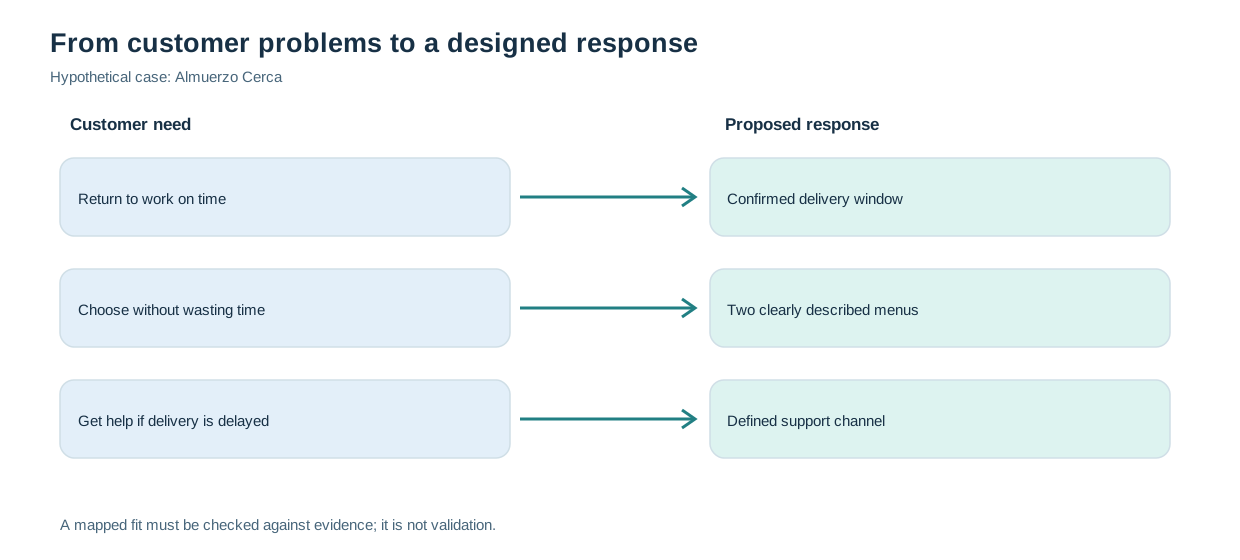
| Customer job or difficulty | Offer element | Promised benefit | Evidence still needed |
|---|---|---|---|
| Eat within a short break | Agreed delivery window | Less uncertain waiting | Actual reliability and relevance |
| Choose without spending much time | Two clearly described menus | Easier decision | Preferences and restrictions |
| Know what to do if an order is late | Support channel with defined response | Lower uncertainty | Actual response capacity |
The entire case is hypothetical. None of these promises has been shown to be important or profitable.
Step 3. Compare with the current outcome, not an imaginary competitor
The alternative could be a restaurant, bringing lunch from home, or buying nothing. Compare total cost, reliability, purchase effort, trust, flexibility, and the risks of switching. A “market gap” is an opportunity only when people experience it and you can address it viably. Link this step to competitive analysis in pillar 1.
Step 4. Write a specific proposition
A useful practical writing template, not an official method, is: “For [segment] needing [outcome] in [context], we offer [solution or service] that [specific benefit], unlike [alternative] because [verified or unverified distinction].” When you do not know the differentiator, mark it as a hypothesis and investigate.
Hypothetical example: “For office teams with short lunch breaks, Almuerzo Cerca offers a limited-menu lunch delivered within a confirmed window, reducing uncertainty around arrival.” We do not claim to be cheaper, faster, or healthier than competitors without supporting evidence.
Step 5. Check that you can deliver and charge for the promise
Punctuality requires logistics; customization requires inventory and preparation; low pricing requires sufficient margin. Connect the offer to capabilities and resources, perceived value and pricing, and business viability. A commercial advantage is not sustainable if it destroys the economics of the business.
Questions about interest, delivery capability, and economics can be separated using hypothesis types.
Mistakes and limits
Do not use “innovative,” “leading,” or “highest quality” as replacements for precise outcomes. Do not turn interviews about hypothetical desires into proof of purchase. Do not mistake a value proposition for an advertisement, logo, or feature list. Avoid making promises your partners cannot fulfill.
Final check: promise, evidence, and sacrifice
Before publishing a proposition, create three columns: “what we promise,” “what evidence supports it,” and “what customers give up to obtain it.” If promising less waiting, distinguish technical ability to deliver from the experience buyers have actually observed. If switching suppliers requires learning a new process, that friction belongs in the comparison. Do not publish “always on time” as fact when all you have is a plan. A credible proposition can state a target offer and service conditions without inventing past performance.
To examine benefits that are still assumptions, move on to choosing an experiment based on evidence, cost, and time. Writing a promise does not by itself show that customers value it or that you can deliver it.
What you should have when you finish
One segment profile, a jobs-pains-gains table, offer map, short proposition, comparison with alternatives, and list of assumptions. Sources: [R03][R05][R01].
Bibliography and references
- [R03] Strategyzer — Value Proposition Canvas. https://www.strategyzer.com/library/the-value-proposition-canvas — Jobs, pains, gains y mapeo de la oferta; encaje hipotético.
- [R05] GOV.UK — Learning about users and their needs. https://www.gov.uk/service-manual/user-research/start-by-learning-user-needs — Necesidades reales, formulación basada en resultados y evidencia.
- [R01] Strategyzer — The Business Model Canvas. https://www.strategyzer.com/library/the-business-model-canvas — Nueve bloques interdependientes y uso iterativo del Canvas.